
Local SEO has become an essential part of digital marketing for businesses that depend on customers from specific cities, neighborhoods, or service areas. In 2026, businesses need more than basic keyword optimization to improve local search visibility and attract qualified customers.
A Powerful local SEO expert in Pakistan can help businesses build a stronger local presence by optimizing Google Business Profiles, websites, citations, reviews, and location-focused content. These elements work together to improve local rankings and increase opportunities to appear when potential customers search for nearby services.
For businesses competing in major cities, an Advanced local SEO expert in Lahore can use location-based keywords, locally relevant landing pages, and Google Maps optimization to strengthen visibility. Local search optimization is particularly valuable for companies that want customers to visit a physical location or contact a service provider.
An Expert local SEO expert in Karachi can also focus on improving local business SEO through customer reviews, NAP consistency, local citations, and relevant website content. These factors help search engines understand where a business operates and whether it is relevant to a user’s search intent.
Similarly, a Strategic local SEO expert in Islamabad, a Proven local SEO expert in Hyderabad, and Ameer SEO can help businesses develop location-focused strategies designed around their target customers. The right approach combines technical optimization, Google Business Profile management, content, reputation signals, and local authority.
What Is Local SEO?
Local SEO is the process of optimizing a business’s online presence so it can appear more prominently for searches connected to a specific geographic location. It helps businesses reach people searching for products or services in a particular city, area, neighborhood, or nearby location.
Unlike traditional SEO, which can target users from a broad geographic area, local SEO focuses heavily on geographic relevance. Search engines evaluate factors such as relevance, proximity, prominence, business information, reviews, citations, and website content when determining local results.
For example, a person searching for “plumber near me” has a strong local search intent. Google may display a local pack containing nearby businesses, Google Maps results, and organic listings that appear relevant to the searcher’s location.
Why Local SEO Is Important in 2026
Local search continues to influence how consumers discover businesses. People increasingly use search engines and map platforms to find restaurants, healthcare providers, contractors, agencies, retailers, and other local services.
A well-optimized local presence can increase search visibility, website traffic, phone calls, direction requests, inquiries, and physical visits. It can also help smaller businesses compete against larger companies within specific geographic markets.
Mobile local search is another important consideration. Customers often search while they are traveling or when they immediately need a nearby product or service. Businesses that provide accurate information and strong local relevance can capture these high-intent searches.
5 Important Aspects of Local SEO in 2026
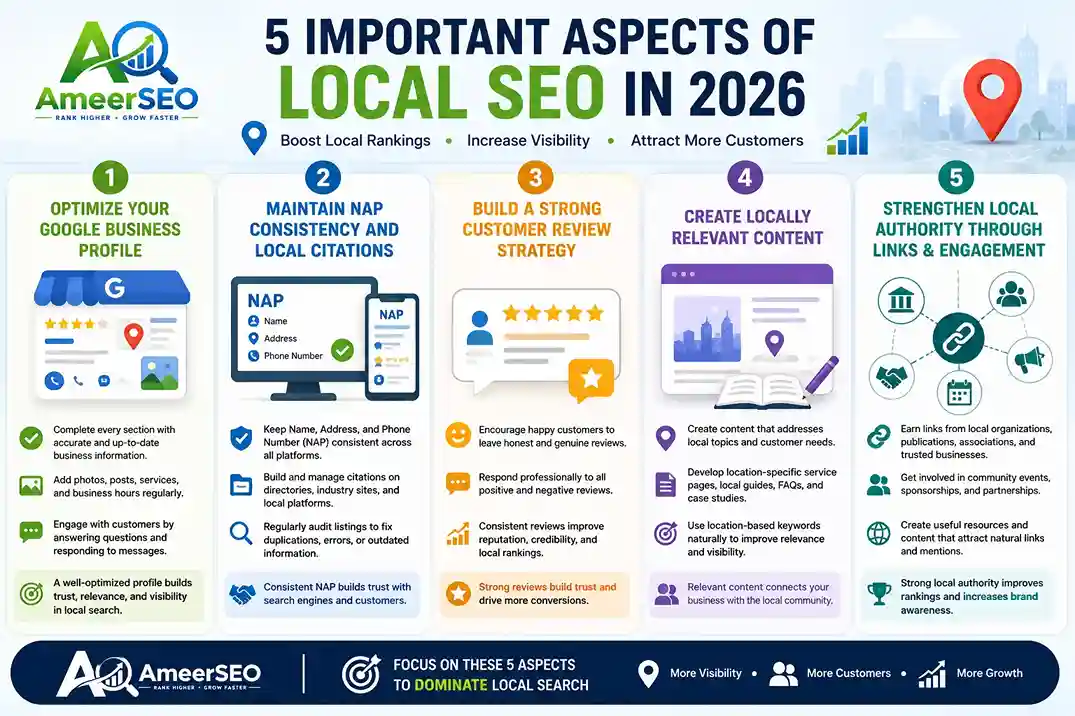
1. Optimize Your Google Business Profile
Google Business Profile remains one of the most important elements of local SEO. A complete and accurate profile gives Google and potential customers useful information about a business, including its name, address, phone number, website, category, services, hours, photos, and other details.
Businesses should make sure their primary category accurately represents their main service. Additional categories can be used when appropriate, while services and business descriptions should clearly communicate what the company offers.
Regularly updating photos, publishing relevant posts, answering questions, and keeping business information accurate can also strengthen customer engagement. A well-maintained profile provides stronger signals of relevance and credibility.
2. Maintain NAP Consistency and Local Citations
NAP stands for Name, Address, and Phone number. Consistent NAP information across the website, Google Business Profile, directories, social profiles, and other platforms helps search engines associate different references with the same business.
Local citations are online mentions of a business’s information. They can appear in business directories, industry websites, local publications, chambers of commerce, and other relevant platforms.
Businesses should audit their existing listings and correct duplicate, outdated, or inconsistent information. Accurate local business listings can support trust and make it easier for both search engines and customers to verify business details.
3. Build a Strong Customer Review Strategy
Customer reviews are an important component of local search visibility and reputation management. Genuine positive reviews can influence potential customers while providing search engines with additional signals about a business.
Businesses should encourage satisfied customers to leave honest reviews without using manipulative or prohibited practices. Responding professionally to both positive and negative feedback also demonstrates customer engagement.
A consistent review strategy can improve credibility, strengthen the online reputation of a business, and potentially increase conversions from local search results.
4. Create Locally Relevant Content
Local content optimization helps search engines understand the geographic areas and topics associated with a business. Instead of creating generic content, businesses can publish useful information addressing the needs of customers in their target locations.
Location-specific service pages can be particularly effective when they provide genuinely useful information rather than simply repeating a city name. For example, a landscaping company could create a detailed service page explaining lawn care considerations specific to a particular city.
Businesses can also publish local guides, FAQs, case studies, community information, project examples, and location-focused articles. This approach establishes local relevance while creating additional opportunities to target location-based keywords.
5. Strengthen Local Authority Through Links and Engagement
Local link building can help establish authority within a geographic market. Relevant links from local organizations, publications, industry associations, community websites, and trusted businesses can provide useful contextual signals.
The goal should not be to collect as many links as possible. Instead, businesses should focus on earning relevant and trustworthy links that make sense for their industry and location.
Local partnerships, sponsorships, community involvement, digital PR, local events, and useful resources can create legitimate opportunities for local links. These activities can also increase brand awareness beyond search engines.
Local SEO Ranking Factors to Watch in 2026
Local rankings are influenced by several interconnected signals. Google generally considers relevance, distance, and prominence when determining which businesses are appropriate for a local search.
Relevance refers to how closely a business matches the search query. Accurate categories, services, website content, and business information can help establish relevance.
Distance considers how close the business is to the searcher’s location or the geographic area included in the search. This means businesses cannot always rank everywhere, even when their websites are well optimized.
Prominence relates to how well-known and authoritative a business appears to be. Reviews, links, citations, mentions, and overall online presence can contribute to this broader concept of prominence.
Local SEO vs Traditional SEO
| Factor | Local SEO | Traditional SEO |
|---|---|---|
| Primary Focus | Geographic visibility | Broader organic visibility |
| Main Audience | Local customers | Regional, national, or global users |
| Google Business Profile | Highly important | Usually less central |
| Google Maps | Major focus | Limited relevance |
| Local Citations | Important | Generally less important |
| NAP Consistency | Essential | Usually not a major ranking factor |
| Reviews | Important for reputation and local visibility | Useful but less location-focused |
| Location Keywords | Frequently targeted | Used according to search intent |
| Local Links | Highly valuable | Relevant backlinks are valuable |
| Main Goal | Local leads, calls, visits, and customers | Organic traffic, leads, and conversions |
How to Improve Local Search Visibility
Businesses should begin with a complete local SEO audit. The audit can identify problems with Google Business Profile information, website optimization, citations, reviews, technical SEO, local landing pages, and backlinks.
Keyword research should then identify the terms potential customers actually use. This can include service-related phrases, city names, neighborhood terms, and conversational searches such as “near me” queries.
The website should clearly communicate the business’s services and service areas. Important information should be easy to find, while location pages should provide unique and useful content rather than thin pages created only to target keywords.
Optimize for “Near Me” Searches
Near me searches represent strong local intent because users are often looking for an immediate solution. Examples include “SEO agency near me,” “dentist near me,” “restaurant near me,” and “electrician near me.”
Businesses cannot simply insert “near me” repeatedly into website content and expect better rankings. Search engines use geographic signals, business information, relevance, and proximity to determine appropriate local results.
Maintaining accurate location information, optimizing Google Business Profile, developing useful local content, and building a strong local presence are more sustainable ways to improve visibility for these searches.
Mobile Optimization and Local Search
Many local searches happen on smartphones, making mobile optimization an important part of a modern local SEO strategy. A website should load quickly, display correctly, and allow users to easily find contact information.
Click-to-call functionality can be particularly valuable for service businesses. Directions, booking options, contact forms, service information, and business hours should also be easy to access from mobile devices.
A poor mobile experience can cause potential customers to leave before contacting the business. Therefore, technical SEO and user experience should support the overall local search strategy.
Local Keyword Research Strategy
Local keyword research should begin with the services or products a business provides. Geographic modifiers can then be added where they accurately reflect how customers search.
For example, a company might target terms such as “digital marketing agency Islamabad,” “SEO services Lahore,” or “roofing contractor Karachi.” More specific long-tail searches can target particular services and locations.
Search intent should remain the priority. Keywords should be incorporated naturally into titles, headings, content, URLs, internal links, and relevant metadata rather than being unnecessarily repeated.
Local Landing Pages
Location pages can help businesses target multiple service areas, but each page should provide meaningful value. Simply replacing a city name across identical pages can create a poor user experience and weak content.
A useful location page can discuss the company’s services, local customer needs, service coverage, projects, FAQs, testimonials, and other information genuinely relevant to that location.
Businesses serving several cities should create a logical internal linking structure between service pages and location pages. This helps users navigate the website and allows search engines to better understand the site’s topical and geographic relationships.
Reviews and Local Customer Trust
Reviews influence how customers perceive a business before they make contact. A company with a strong collection of authentic reviews can appear more trustworthy than a competitor with little or no customer feedback.
Businesses should create a simple process for requesting reviews from genuine customers. They should never purchase fake reviews or manipulate ratings because such practices can damage reputation and potentially violate platform policies.
Responding to reviews is equally important. Professional responses can demonstrate that the business values customer feedback and actively manages its online presence.
Measuring Local SEO Performance
Local SEO performance should be measured using meaningful business outcomes rather than rankings alone. Important metrics can include local organic traffic, Google Business Profile interactions, phone calls, direction requests, website inquiries, bookings, and conversions.
Rank tracking can also help businesses monitor visibility for important local keywords. However, rankings may vary according to location, device, search history, and other factors.
Google Search Console, Google Analytics, Google Business Profile insights, and suitable SEO platforms can be combined to create a broader view of local performance.
Common Local SEO Mistakes to Avoid
One common mistake is creating incomplete or inaccurate Google Business Profile information. Incorrect phone numbers, addresses, business hours, categories, or service information can reduce customer trust and create confusion.
Another problem is inconsistent citations. Businesses should regularly review major directories and important industry listings to identify duplicate or outdated information.
Keyword stuffing is also ineffective. Repeating city names excessively can make content difficult to read and may create a poor user experience. Local SEO should focus on relevance, usefulness, and natural language.
Businesses should also avoid creating dozens of nearly identical location pages. Every location page should have a clear purpose and provide information that genuinely helps people in that area.
Local SEO Strategy for Small Businesses
Small businesses can compete effectively by focusing on a defined geographic market. Rather than trying to rank nationally for highly competitive terms, they can build authority around their most valuable locations and services.
The strategy should begin with Google Business Profile optimization, accurate citations, strong reviews, technical website health, and useful local content. Once these foundations are established, businesses can expand into local link building and more advanced content strategies.
Consistency is critical. Local SEO is not a one-time task because business information, customer reviews, competitors, search behavior, and search engine systems can change over time.
5 Local SEO Tips for Better Results in 2026
The first priority is to make your Google Business Profile complete, accurate, and relevant to your primary service. This creates a strong foundation for Google Maps visibility and local discovery.
The second priority is maintaining consistent business information across important platforms. Accurate NAP data and relevant citations help establish a reliable digital identity.
The third priority is building a sustainable review process. Authentic customer feedback can strengthen trust and provide valuable reputation signals.
The fourth priority is creating genuinely useful location-focused content. Service pages, local guides, FAQs, and case studies can help demonstrate geographic relevance.
The fifth priority is developing local authority through relevant links, community relationships, useful resources, and ongoing engagement. Combining these activities produces a more comprehensive local SEO strategy.
Frequently Asked Questions About Local SEO
What is the most important factor in local SEO?
There is no single factor that guarantees local rankings. Relevance, distance, and prominence are fundamental concepts, while Google Business Profile optimization, reviews, citations, website quality, and local authority all contribute to overall local search performance.
How long does local SEO take to work?
Local SEO results vary depending on competition, location, website authority, existing optimization, and the quality of the strategy. Some improvements may become visible relatively quickly, while competitive local markets can require several months of consistent optimization.
Does Google Business Profile improve local SEO?
A properly optimized Google Business Profile can significantly improve a business’s ability to appear in Google Maps and local search features. Accurate information, relevant categories, services, photos, reviews, and ongoing profile management can all contribute to a stronger local presence.
Are reviews a local SEO ranking factor?
Reviews are an important part of local search and reputation. The quality, quantity, and recency of reviews can influence how customers perceive a business, while review-related signals are also considered within Google’s local search systems.
How important are local citations in 2026?
Local citations remain useful when they are accurate, relevant, and trustworthy. Businesses should prioritize important directories and industry-specific or geographically relevant platforms rather than attempting to create large numbers of low-quality listings.
Should every business create location pages?
Not necessarily. Location pages are most useful when a business genuinely serves multiple areas and can provide unique, valuable information for each location. Creating thin or duplicate pages solely to target city names is not a strong strategy.
How can I rank higher on Google Maps?
Start by accurately optimizing your Google Business Profile, selecting appropriate categories, maintaining consistent business information, earning authentic reviews, improving website relevance, and developing legitimate local authority. Proximity also plays an important role and cannot always be overcome through optimization.
What are the best local SEO strategies for small businesses?
Small businesses should focus on their most valuable locations and services rather than trying to target everything at once. A combination of Google Business Profile optimization, reviews, local content, citations, technical SEO, and relevant local links can create a strong foundation.
Is local SEO still important in 2026?
Yes. Local SEO remains highly valuable for businesses that depend on customers within specific geographic areas. As consumers increasingly use search engines, maps, mobile devices, and location-based queries to find businesses, maintaining strong local visibility can support leads and sales.
Conclusion
Local SEO in service in Pakistan requires a comprehensive approach rather than relying on a single optimization technique. Google Business Profile, NAP consistency, reviews, locally relevant content, citations, technical optimization, and local authority should work together as part of one strategy.
The five core priorities are clear: optimize your Google Business Profile, maintain accurate citations, build authentic reviews, create useful local content, and strengthen local authority. Businesses that consistently improve these areas can establish stronger visibility and attract customers with high local search intent.
The most effective local SEO strategy is not simply about ranking for more keywords. It is about becoming more relevant, trustworthy, and visible to the customers who matter most in your target locations.