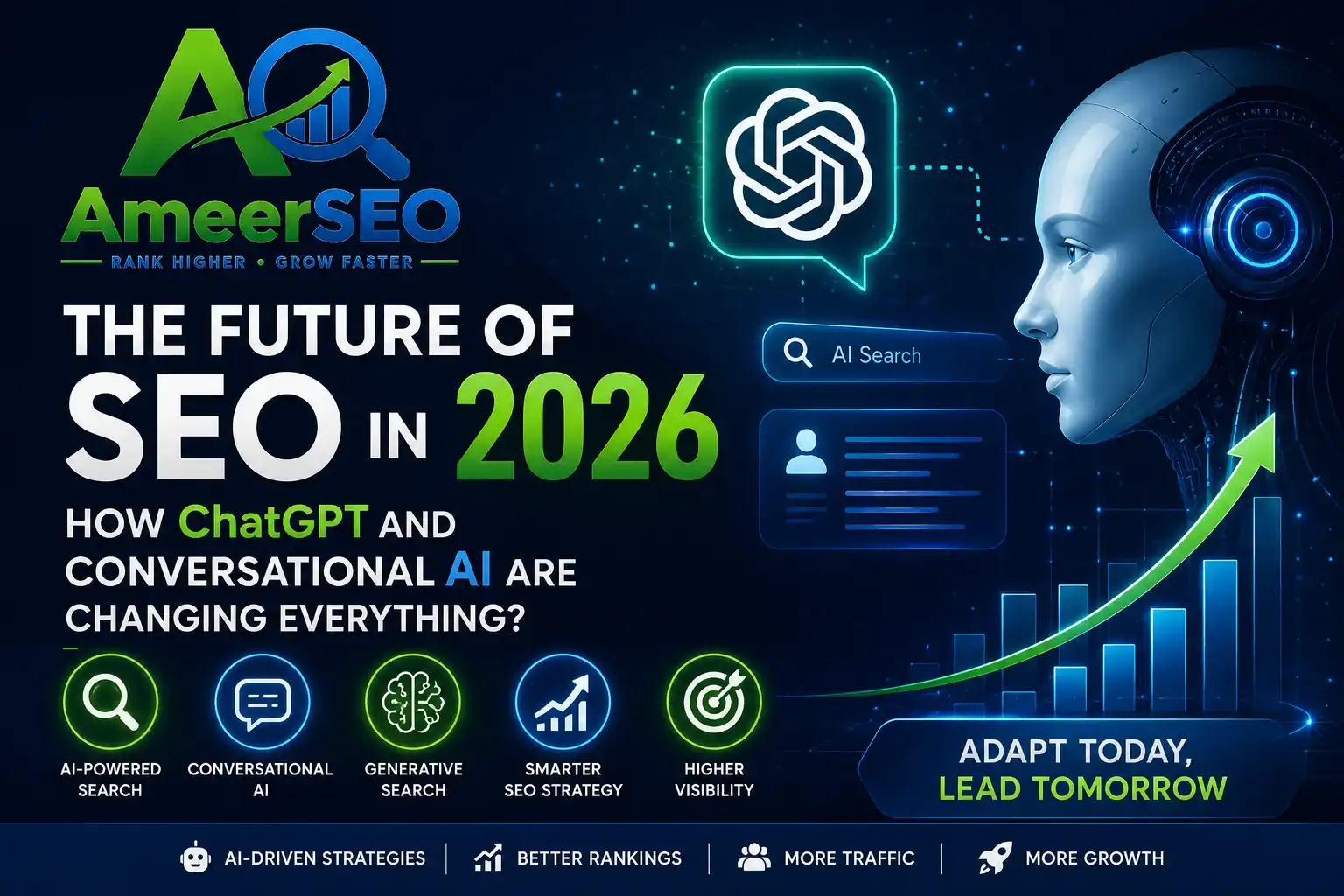
Ameer SEO helps businesses understand how search is evolving as artificial intelligence, conversational platforms, and generative search become a bigger part of the digital landscape. Traditional search engine optimization is no longer only about ranking blue links. Businesses now need to create useful, authoritative, and context-rich content that can perform across modern search experiences.
The best digital marketing service in Pakistan is increasingly connected with advanced SEO, AI-powered content strategies, technical optimization, and digital visibility across multiple search platforms. As users increasingly ask complete questions instead of typing short keywords, businesses must adapt their SEO strategies to match conversational search behavior.
What Is the Future of SEO in 2026?
The future of SEO in 2026 is moving toward a more intelligent and user-focused search experience. Search engines and AI platforms are becoming better at understanding context, intent, entities, relationships, and natural language rather than relying primarily on exact keyword matching.
Artificial intelligence is changing how people discover information, products, services, and businesses. Google AI Overviews, ChatGPT, conversational assistants, and other AI-powered search experiences can provide direct answers instead of requiring users to visit several websites.
This does not mean traditional SEO is disappearing. Instead, SEO is expanding. Websites still need strong technical foundations, valuable content, authoritative backlinks, good user experience, structured data, and clear topical relevance.
How ChatGPT Is Changing SEO
ChatGPT has changed how users interact with information. Instead of searching for several individual keywords, users can ask detailed questions and continue the conversation with follow-up queries.
This creates an important shift from traditional keyword optimization toward conversational search optimization. Content needs to answer questions naturally while providing sufficient context for AI systems to understand the subject accurately.
ChatGPT also influences content creation, keyword research, content planning, competitor analysis, and SEO workflows. However, AI-generated content still requires human expertise, fact-checking, originality, and editorial oversight to provide genuine value.
How Conversational AI Is Changing Search
Conversational AI allows users to communicate with search systems in a more natural way. Someone looking for an SEO agency might ask, “Which SEO company can help a small business increase local visibility?” rather than simply searching for “SEO company.”
This means search intent is becoming more important than individual keywords. Websites that understand the questions, problems, and goals of their target audiences have greater opportunities to become useful sources in conversational search.
Natural language processing also allows AI systems to understand synonyms, related concepts, context, and relationships between entities. As a result, semantic relevance and topical authority are becoming increasingly important.
Traditional SEO vs AI-Powered Search
Traditional search generally provides a list of webpages that users evaluate themselves. AI-powered search can summarize information, compare sources, answer follow-up questions, and provide recommendations within a conversational interface.
| SEO Factor | Traditional Search | AI-Powered Search |
|---|---|---|
| Search behavior | Short keyword queries | Conversational questions |
| Main objective | Rank webpages | Become a trusted information source |
| Keyword usage | Important | Context and intent are more important |
| Content format | Articles and landing pages | Direct, contextual answers |
| Search results | Blue links and features | AI-generated answers and citations |
| Authority | Backlinks and relevance | Expertise, authority, trust, and source quality |
| User journey | Search → click → website | Question → AI answer → possible source visit |
| Optimization | Traditional SEO | SEO + AI visibility + semantic optimization |
The Rise of AI Search Engines
AI search engines are changing the way users interact with online information. Rather than presenting only a collection of links, these systems can combine information from multiple sources and generate a contextual response.
Google’s AI-powered search features, ChatGPT, and other generative search platforms are contributing to this transformation. Businesses therefore need to consider where their content appears across traditional and AI-driven search experiences.
The future search environment will likely involve multiple discovery channels. Google results, AI assistants, conversational platforms, voice search, social platforms, maps, and specialized search tools can all contribute to how users find a business.
Search Intent Is More Important Than Ever
Search intent describes the reason behind a user’s query. A person searching “SEO services” may want to learn about SEO, compare agencies, or hire a provider.
AI systems are increasingly capable of interpreting this underlying purpose. Content that satisfies search intent comprehensively can therefore have an advantage over content created simply to include a target keyword repeatedly.
Successful SEO in 2026 requires understanding informational, commercial, navigational, and transactional intent and creating content that addresses the appropriate stage of the customer journey.
Semantic SEO and Contextual Relevance
Semantic SEO focuses on meaning and relationships rather than isolated keywords. Search engines use natural language processing, knowledge graphs, entities, and contextual signals to understand what a page is actually about.
For example, an article about “technical SEO” may naturally discuss crawling, indexing, Core Web Vitals, XML sitemaps, canonical URLs, robots.txt, structured data, and JavaScript rendering.
These related concepts help establish topical depth. Businesses should therefore create comprehensive content ecosystems instead of producing many thin pages targeting slightly different keyword variations.
Topical Authority Will Become More Important
Topical authority refers to demonstrating comprehensive knowledge about a particular subject. A website that consistently publishes useful content covering multiple aspects of SEO can establish stronger topical relevance than a website with only one general SEO article.
In 2026, content strategies should connect related topics logically. Pillar pages can cover broad subjects while supporting articles address specific questions and subtopics.
Internal linking can then help users and search systems understand the relationship between these pages. This creates a structured content ecosystem that supports both traditional search and AI-driven discovery.
Generative Engine Optimization and AI Visibility
Generative Engine Optimization, commonly called GEO, focuses on improving the likelihood that a brand or website is represented accurately and prominently within AI-generated responses.
Traditional SEO primarily focuses on rankings in search engine results pages. GEO considers visibility within generative answers, AI assistants, conversational search platforms, and other AI-powered discovery experiences.
Businesses can strengthen AI visibility by publishing authoritative information, demonstrating expertise, maintaining consistent brand information, earning credible mentions, and creating content that clearly answers relevant questions.
Why E-E-A-T Matters in AI Search
Experience, Expertise, Authoritativeness, and Trustworthiness remain important principles for creating high-quality content. AI systems need reliable information, especially when generating answers that users may depend upon.
Websites should demonstrate who created their content, why they are qualified to discuss the subject, and how their information is supported.
First-hand experience can also make content more valuable. Case studies, original research, examples, expert opinions, customer experiences, and practical insights can differentiate a website from generic AI-generated material.
AI Content Optimization in 2026
Artificial intelligence can accelerate content research and production, but simply publishing large volumes of AI-generated articles is not a sustainable SEO strategy.
AI content should be reviewed for accuracy, originality, relevance, readability, and usefulness. Human expertise should be added wherever the subject requires professional knowledge or first-hand experience.
The strongest approach combines AI efficiency with human judgment. AI can help identify content gaps and organize ideas, while experienced writers and SEO professionals ensure that the final content provides meaningful value.
Voice Search and Conversational Queries
Voice search naturally encourages conversational queries. Users may ask complete questions such as “What are the best SEO strategies for a local business?” instead of typing short phrases.
This trend overlaps with conversational AI because both depend heavily on natural language and contextual understanding.
Businesses should create content that directly answers common customer questions. Clear headings, concise explanations, FAQ sections, and structured information can make content easier for both users and search systems to understand.
Structured Data and AI Search
Structured data helps search engines understand the meaning and relationships within webpage content. Schema markup can identify organizations, products, services, articles, reviews, events, FAQs, and other entities where supported and appropriate.
Although structured data does not guarantee AI visibility or rankings, accurate implementation can provide search engines with clearer information about a website and its content.
Businesses should therefore maintain technically sound websites with crawlable pages, logical architecture, descriptive metadata, clean URLs, appropriate schema markup, and strong internal linking.
The Role of Backlinks in AI SEO
Backlinks remain an important component of authority, but the quality and relevance of links matter more than simply accumulating large numbers of backlinks.
Links from trustworthy and contextually relevant websites can help establish credibility. Brand mentions and citations across reputable sources may also contribute to how an organization is understood across the broader web.
The future of link building is therefore likely to emphasize genuine digital authority rather than mass-produced or low-quality links.
Zero-Click Searches and the Changing Customer Journey
Zero-click searches occur when users receive enough information directly within the search experience that they do not need to click a traditional result.
AI-generated answers may increase this behavior because users can receive summaries without immediately visiting individual webpages.
However, visibility can still provide value. A brand mentioned or cited within an AI response may gain awareness and credibility even when the user does not immediately click through.
How Businesses Should Prepare for the Future of SEO
Businesses should build content around real customer questions instead of focusing exclusively on keyword volume. Each important topic should be addressed with accurate, comprehensive, and easy-to-understand information.
Websites should also strengthen their technical SEO foundations. Fast loading performance, mobile usability, crawlability, indexing, internal linking, structured data, and secure connections remain important regardless of how search interfaces evolve.
Brand authority should also become a strategic priority. Consistent business information, expert contributions, credible mentions, quality backlinks, original research, and strong customer experiences can help establish trust across the digital ecosystem.
SEO Strategies for the AI Era
A successful SEO strategy in 2026 should combine traditional optimization with AI search optimization. Keyword research remains useful, but it should be expanded with search intent, entities, related concepts, conversational queries, and topical relationships.
Content should answer the primary question quickly and then provide deeper information for readers who need more detail. This structure works well for both human readers and systems that need to identify useful passages.
Businesses should also monitor how their brands appear in AI-generated answers. AI visibility is becoming another important digital marketing metric alongside rankings, organic traffic, conversions, branded searches, and engagement.
Will ChatGPT Replace Google?
ChatGPT and other conversational AI platforms are changing how people search, but it is unlikely that one platform will completely replace every traditional search behavior.
Google remains deeply integrated with webpages, maps, shopping, local businesses, images, videos, news, and other search experiences. Meanwhile, conversational AI is particularly useful for research, explanations, comparisons, brainstorming, and complex questions.
The more likely future is a fragmented search ecosystem where users move between traditional search engines, AI assistants, social platforms, marketplaces, and specialized discovery tools.
Will Traditional SEO Become Obsolete?
Traditional SEO is not becoming obsolete. Its purpose is expanding.
Technical SEO, content quality, backlinks, internal linking, crawlability, user experience, and search intent will continue to influence visibility. What is changing is the number of places where optimization matters.
SEO professionals increasingly need to think beyond traditional rankings and consider AI visibility, conversational search, entity recognition, brand authority, and generative search experiences.
The Future of Organic Traffic
Organic traffic will continue to matter, but the path from discovery to website visit may become more complicated. Some users will still click traditional search results, while others may interact with AI-generated answers before visiting a source.
This makes brand recognition particularly valuable. If users repeatedly encounter a company across search engines, AI responses, social platforms, reviews, and other digital channels, that brand can become more familiar and trusted.
SEO should therefore be viewed as a broader digital visibility strategy rather than simply a method for achieving higher Google rankings.
How to Optimize Content for AI Search
Content should use natural language and provide direct answers to specific questions. Instead of forcing exact-match keywords into every paragraph, writers should cover the subject comprehensively using relevant entities, concepts, examples, and related questions.
Clear headings and logical content structures also help organize information. Important claims should be supported by trustworthy sources, while factual information should be reviewed regularly.
Original insights can provide another advantage. Case studies, statistics, expert commentary, practical examples, and first-hand observations can make content more distinctive and valuable than generic material.
SEO Trends to Watch in 2026
The most important SEO trends include AI-powered search, conversational queries, generative engine optimization, semantic SEO, entity-based optimization, zero-click experiences, topical authority, first-hand content, and increasingly personalized search.
Another major development is the convergence of SEO with broader digital marketing. Search visibility is no longer isolated from brand building, content marketing, public relations, social media, reviews, and customer experience.
Organizations that adapt early can build stronger digital visibility while competitors continue relying exclusively on traditional keyword-ranking strategies.
Frequently Asked Questions
The future of SEO in 2026 is centered around search intent, semantic relevance, topical authority, AI-powered search, conversational queries, and high-quality content. Traditional SEO remains important but is expanding into AI visibility and generative search optimization.
ChatGPT is changing SEO by encouraging conversational search behavior and providing direct AI-generated answers. It is also influencing content research, keyword analysis, content planning, and how businesses think about visibility beyond traditional search results.
AI is unlikely to completely replace SEO. Instead, artificial intelligence is changing how SEO is performed and where optimization takes place. Technical SEO, content quality, authority, user experience, and search intent will continue to matter.
Generative Engine Optimization is the practice of improving a brand's visibility and representation within AI-generated search experiences. It complements traditional SEO by focusing on AI assistants and generative search platforms.
Yes. Keyword research remains useful for understanding demand and search behavior. However, it should be combined with search intent, semantic relationships, entities, conversational queries, and broader topic coverage.
Businesses can optimize for AI search by publishing authoritative content, answering relevant questions, strengthening topical authority, maintaining accurate business information, earning credible mentions, improving technical SEO, and demonstrating genuine expertise.
AI-generated content is not automatically harmful simply because AI was used to create it. The important factors are quality, usefulness, accuracy, originality, and whether the content satisfies users. Poor-quality, repetitive, or misleading content can perform poorly regardless of how it was produced.
AI-generated answers and enhanced search features may increase zero-click behavior because users can obtain information directly within search interfaces. Businesses should therefore focus on visibility, brand recognition, authority, and conversions in addition to traditional website traffic.
E-E-A-T helps demonstrate that content comes from credible and trustworthy sources. Experience, expertise, authoritativeness, and trustworthiness are especially valuable as AI systems increasingly need reliable information from authoritative sources.
Conclusion
The future of SEO in 2026 is not about choosing between traditional search and artificial intelligence. It is about adapting SEO to a broader search ecosystem where Google, ChatGPT, conversational AI, voice assistants, and generative search platforms all influence how people discover information.
Businesses that focus on genuine expertise, useful content, semantic relevance, technical excellence, and strong brand authority will be better positioned for this transition. The winning strategy is to optimize not only for rankings, but also for visibility, credibility, context, and user intent across every major search experience.