

Reciprocal links have been a part of search engine optimization for many years. If you are learning SEO, you may have come across the term “reciprocal link” while researching backlink strategies. Understanding reciprocal links is important because backlinks remain one of the strongest ranking factors used by search engines. However, not all backlinks are created equal, and the way reciprocal links are used can determine whether they help or hurt your website.
This guide explains what reciprocal links are, how reciprocal links work, their benefits and risks, Google’s stance on reciprocal linking, and how to build reciprocal links safely. Whether you manage a personal blog, business website, or provide SEO services in Pakistan, this guide will help you understand the role of reciprocal linking in modern SEO.
What Is a Reciprocal Link?
A reciprocal link is a link exchange between two websites. In simple terms, Website A links to Website B, and Website B links back to Website A. This creates a mutual backlink relationship between both sites.
For example, a digital marketing blog may link to a web design company as a helpful resource. In return, the web design company may link back to the marketing blog because it provides useful information to its audience. This type of relationship is known as reciprocal linking.
Reciprocal links are common on the internet and often occur naturally when websites reference each other’s content.
How Reciprocal Links Work in SEO
Search engines use backlinks as signals of trust, relevance, and authority. When one website links to another, it acts as a recommendation. Reciprocal links work similarly, except both websites exchange recommendations.
When search engines discover reciprocal backlinks, they evaluate several factors including relevance, content quality, authority, and the intent behind the exchange. A natural reciprocal link between relevant websites may provide value to users and contribute positively to SEO.
However, excessive link exchange solely for ranking manipulation can violate Google’s guidelines and lead to reduced SEO effectiveness.
Reciprocal Links vs One-Way Backlinks
One-Way Backlinks
A one-way backlink occurs when Website A links to Website B without receiving a link in return. Search engines often consider these backlinks more natural because they represent independent recommendations.
Reciprocal Backlinks
A reciprocal backlink exists when both websites link to each other. These links can still provide value when they are relevant and naturally placed within quality content.
The primary difference lies in how search engines interpret the relationship. One-way backlinks generally carry stronger SEO value, while reciprocal links require careful implementation to avoid appearing manipulative.
Why Reciprocal Links Exist
Reciprocal links are not inherently bad. In fact, they are a normal part of how the web functions.
Businesses often partner with complementary organizations and naturally link to each other’s resources. Industry blogs frequently cite one another’s content. Local businesses may reference trusted suppliers, associations, or partners.
These natural relationships create reciprocal links that enhance user experience and provide additional information to visitors.
Benefits of Reciprocal Links
Improved Website Visibility
Reciprocal links can help expose your website to a new audience. Visitors who discover your site through a partner website may become customers, subscribers, or regular readers.
Increased Referral Traffic
One of the most valuable benefits of reciprocal links is referral traffic. Users who click on links from relevant websites often have genuine interest in your content or services.
Better Industry Relationships
Link exchanges can strengthen partnerships within your industry. Building relationships with trusted websites often leads to collaboration opportunities beyond SEO.
Enhanced User Experience
When reciprocal links connect users to relevant resources, they improve navigation and provide additional value. Search engines appreciate websites that prioritize user experience.
Stronger Content Networks
Quality reciprocal links help create a network of authoritative content. This can increase trust and improve the overall usefulness of your website.
Risks of Reciprocal Linking
While reciprocal links offer benefits, they also come with potential risks.
Google May View Excessive Exchanges as Manipulative
Google’s guidelines specifically warn against excessive link exchanges designed solely to manipulate rankings. Large-scale reciprocal linking schemes can trigger spam signals.
Low-Quality Backlink Profile
Exchanging links with irrelevant or low-authority websites can weaken your backlink profile and reduce overall SEO performance.
Loss of Trust
Users may lose trust if they encounter links that appear promotional rather than genuinely helpful. Relevance should always be the primary consideration.
Potential Ranking Issues
Websites that participate in aggressive reciprocal link schemes may experience ranking declines if search engines determine the links are unnatural.
Google’s Guidelines on Reciprocal Links
Google does not prohibit reciprocal links entirely. Instead, Google discourages excessive link exchanges intended to manipulate search rankings.
A few reciprocal links between relevant websites are generally considered natural. Problems arise when websites create large-scale link exchange networks with no real value to users.
Google encourages webmasters to focus on earning links naturally through quality content rather than relying heavily on reciprocal backlink strategies.
Are Reciprocal Links Good or Bad for SEO?
The answer depends on how they are used.
Natural reciprocal links between relevant websites are generally acceptable. They can drive traffic, improve user experience, and strengthen industry relationships.
On the other hand, reciprocal links become problematic when they are exchanged solely for SEO purposes without providing value to users.
The quality of the linking website, content relevance, and overall context determine whether reciprocal links contribute positively to SEO.
How to Build Reciprocal Links Safely
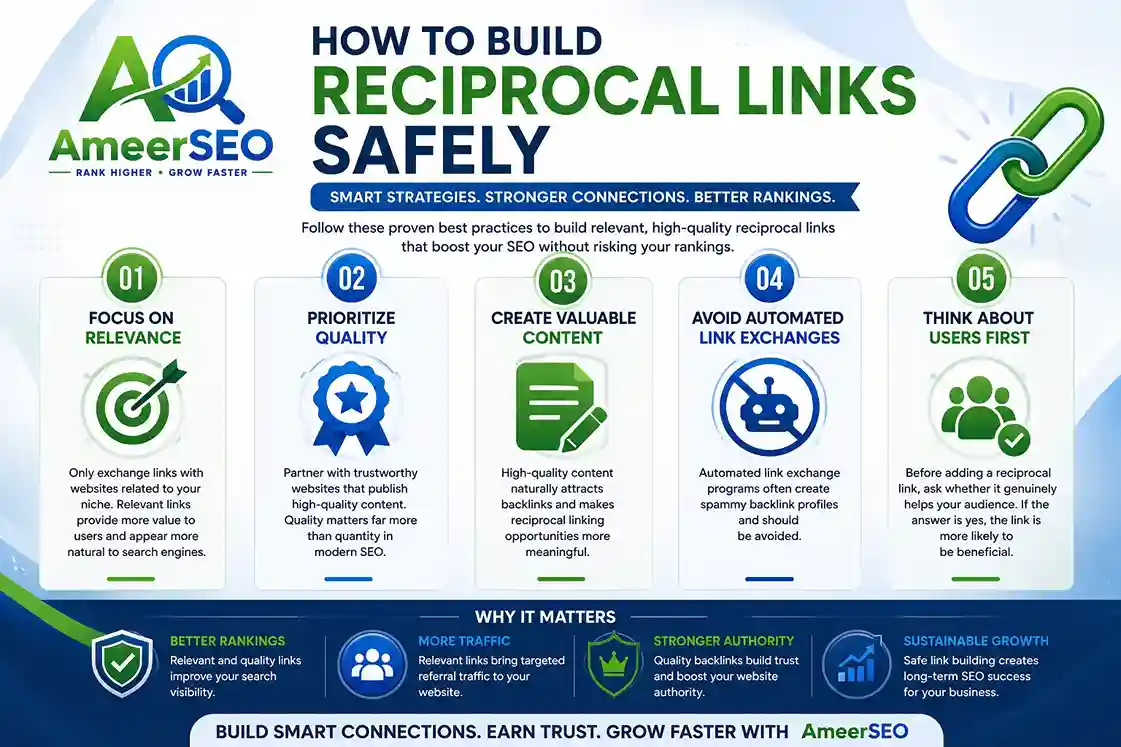
Focus on Relevance
Only exchange links with websites related to your niche. Relevant links provide more value to users and appear more natural to search engines.
Prioritize Quality
Partner with trustworthy websites that publish high-quality content. Quality matters far more than quantity in modern SEO.
Create Valuable Content
High-quality content naturally attracts backlinks and makes reciprocal linking opportunities more meaningful.
Avoid Automated Link Exchanges
Automated link exchange programs often create spammy backlink profiles and should be avoided.
Think About Users First
Before adding a reciprocal link, ask whether it genuinely helps your audience. If the answer is yes, the link is more likely to be beneficial.
Examples of Natural Reciprocal Links in SEO
A web design agency may recommend an SEO consultant to clients who need search engine optimization services. The SEO consultant may also recommend the web design agency to businesses seeking website development.
Similarly, a travel blog may link to a hotel website as a resource for readers. The hotel may later feature the blog in a travel guide section.
These examples demonstrate natural reciprocal linking where both websites provide value to users.
Reciprocal Links and Local SEO
Reciprocal links can play a useful role in local SEO when implemented correctly.
Local businesses often collaborate with chambers of commerce, suppliers, community organizations, and industry partners. These relationships frequently result in reciprocal backlinks.
For businesses offering SEO services in Lahore, building connections with local web design companies, marketing agencies, and business associations can create valuable referral opportunities while supporting local search visibility.
How Reciprocal Links Affect Domain Authority
Although Domain Authority is a third-party metric rather than a Google ranking factor, quality reciprocal links can contribute to overall website authority.
Links from trusted, relevant websites may strengthen your backlink profile and improve authority metrics over time.
However, excessive reciprocal linking with low-quality websites can have the opposite effect and reduce perceived authority.
How to Audit Reciprocal Links
Regular backlink audits help maintain a healthy SEO profile.
Start by identifying websites that link to you and checking whether you also link back to them. Evaluate each reciprocal relationship based on relevance, authority, traffic potential, and user value.
Remove links that appear spammy, irrelevant, or part of outdated link exchange arrangements.
Backlink analysis tools can help monitor reciprocal backlinks and identify potential issues before they impact rankings.
Common Reciprocal Linking Mistakes
Many website owners make the mistake of focusing on quantity instead of quality. Exchanging links with dozens of unrelated websites rarely produces positive SEO results.
Another common mistake is placing reciprocal links on dedicated “links pages” that offer little value to visitors. Search engines prefer contextual links integrated naturally within content.
Ignoring backlink audits can also create problems. Over time, previously valuable reciprocal links may become irrelevant or harmful.
Reciprocal Links vs Link Exchange Networks
There is a significant difference between natural reciprocal links and organized link exchange networks.
Natural reciprocal links occur because websites genuinely find value in each other’s content. Link exchange networks exist primarily to manipulate rankings through large-scale backlink exchanges.
Search engines are increasingly effective at identifying artificial link schemes. As a result, participating in link exchange networks can create substantial SEO risks.
Do Reciprocal Links Improve Search Rankings?
Reciprocal links can contribute to improved search rankings when they are relevant, high quality, and user-focused.
However, they should never be the foundation of your SEO strategy. Strong rankings are typically achieved through a combination of quality content, technical optimization, user experience improvements, and diverse backlink acquisition methods.
Many professionals, including specialists at Ameer SEO, recommend using reciprocal links selectively as part of a broader link-building strategy.
Best Practices for Reciprocal Link Building in 2026
Modern SEO requires a thoughtful approach to reciprocal linking.
Focus on building relationships rather than simply exchanging links. Seek partnerships with websites that serve similar audiences while offering complementary products or services.
Prioritize relevance, quality, and user value in every linking decision. Maintain a natural backlink profile by earning a diverse mix of one-way backlinks, citations, mentions, and organic references.
Most importantly, ensure that every reciprocal link exists because it benefits users rather than because it might influence rankings.
Conclusion
Reciprocal links remain a legitimate part of SEO when used correctly. They occur when two websites link to each other and can provide benefits such as referral traffic, improved visibility, stronger relationships, and enhanced user experience.
The key is moderation and relevance. Search engines recognize that natural reciprocal links are a normal part of the web, but excessive link exchanges designed solely to manipulate rankings can create problems.
By focusing on quality partnerships, valuable content, and user-first linking practices, website owners can safely incorporate reciprocal links into a comprehensive SEO strategy and maintain a healthy backlink profile for long-term success.
Frequently Asked Questions (FAQs)
What is a reciprocal link in SEO?
A reciprocal link is a mutual backlink relationship where two websites link to each other.
Are reciprocal links bad for SEO?
No. Natural reciprocal links between relevant websites are generally acceptable. Problems arise when they are used excessively to manipulate rankings.
Does Google allow reciprocal links?
Yes. Google allows natural reciprocal links but discourages excessive link exchanges intended solely for SEO manipulation.
How many reciprocal links are safe?
There is no fixed number. The focus should be on relevance, quality, and user value rather than quantity.
Do reciprocal links help rankings?
They can help when they come from relevant and authoritative websites. However, they should not be the primary source of backlinks.
What is the difference between reciprocal links and link schemes?
Reciprocal links occur naturally between relevant websites, while link schemes involve large-scale exchanges designed to manipulate search rankings.
Can reciprocal links increase website traffic?
Yes. Relevant reciprocal links can generate referral traffic from users interested in your content, products, or services.
How can I find reciprocal backlinks?
You can use backlink analysis tools such as Google Search Console, Ahrefs, Semrush, or Moz to identify reciprocal backlink relationships.
Should local businesses use reciprocal links?
Yes. Local businesses can benefit from reciprocal links with trusted local partners, associations, and complementary service providers.
What is the best reciprocal linking strategy?
The best strategy is to focus on relevant partnerships, quality websites, helpful content, and user value while avoiding excessive link exchange practices.