

301 redirects are one of the most commonly used tools in technical SEO, yet they are also among the most misunderstood. Many website owners worry that implementing a 301 redirect will cause rankings to drop, reduce organic traffic, or negatively affect search engine visibility. These concerns often arise from outdated information and misconceptions about how search engines handle redirects.
The reality is that 301 redirects play a critical role in preserving SEO value when URLs change, pages are moved, or websites undergo migration. Understanding the facts behind 301 redirects can help businesses make informed decisions and avoid costly SEO mistakes.
In this guide, we will explore how 301 redirects work, their impact on rankings, common myths, proven facts, and best practices for implementing redirects without harming SEO performance.
What Is a 301 Redirect?
A 301 redirect is a permanent redirect that sends users and search engine crawlers from one URL to another. It tells search engines that a page has been permanently moved and that the new URL should replace the old one in search results.
When properly implemented, a 301 redirect transfers ranking signals, backlink value, and authority from the original page to the destination page. This makes permanent redirects an essential part of website restructuring, domain migration SEO, and URL redirects management.
Businesses frequently use 301 redirects when redesigning websites, changing URL structures, consolidating pages, or redirecting deleted pages to relevant alternatives.
How Do 301 Redirects Work?
When a user or search engine requests a URL that has been redirected, the server returns an HTTP status code of 301. This status code informs search engines that the page has permanently moved.
Search engine crawlers then follow the redirect and begin indexing the destination URL instead of the original page. Over time, Google transfers ranking signals, backlink authority, and link equity to the new URL.
This process helps preserve search rankings and minimizes traffic loss during site changes.
Are 301 Redirects Bad for SEO?
The short answer is no.
301 redirects are not bad for SEO when implemented correctly. In fact, they are recommended by Google for handling permanent URL changes.
Problems typically occur when redirects are mismanaged. Issues such as redirect chains, redirect loops, irrelevant destination pages, and poor redirect strategy can create technical SEO problems that impact rankings.
A properly configured 301 redirect helps preserve search engine visibility, maintain backlink value, and improve user experience.
Common Myths About 301 Redirects
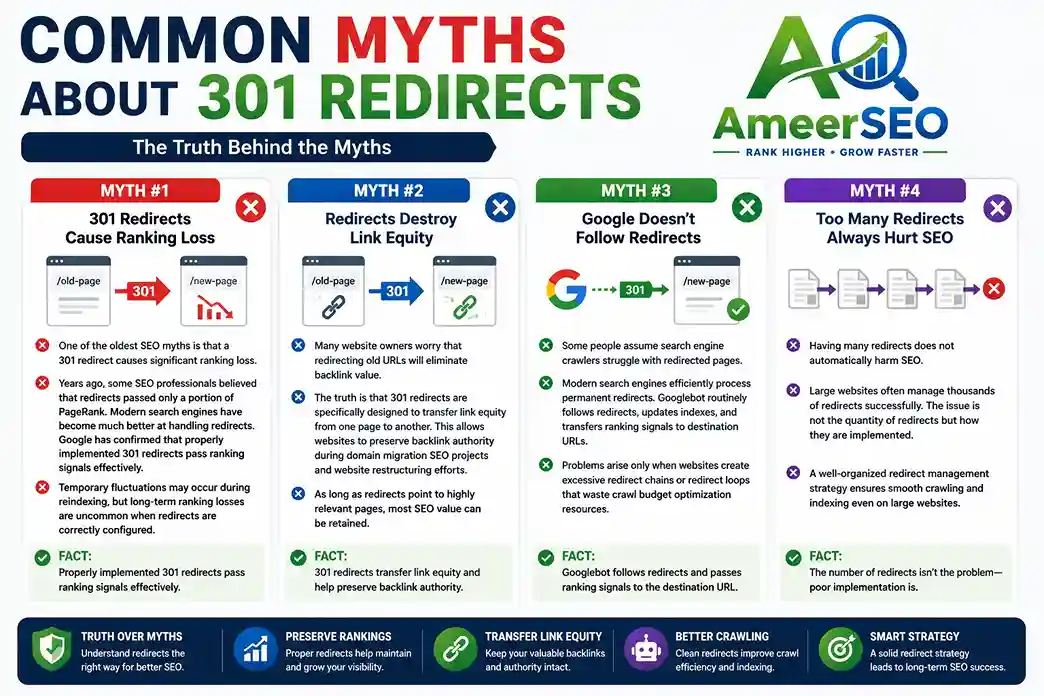
Myth #1 – 301 Redirects Cause Ranking Loss
One of the oldest SEO myths is that a 301 redirect causes significant ranking loss.
Years ago, some SEO professionals believed that redirects passed only a portion of PageRank. Modern search engines have become much better at handling redirects. Google has confirmed that properly implemented 301 redirects pass ranking signals effectively.
Temporary fluctuations may occur during reindexing, but long-term ranking losses are uncommon when redirects are correctly configured.
Myth #2 – Redirects Destroy Link Equity
Many website owners worry that redirecting old URLs will eliminate backlink value.
The truth is that 301 redirects are specifically designed to transfer link equity from one page to another. This allows websites to preserve backlink authority during domain migration SEO projects and website restructuring efforts.
As long as redirects point to highly relevant pages, most SEO value can be retained.
Myth #3 – Google Doesn’t Follow Redirects
Some people assume search engine crawlers struggle with redirected pages.
Modern search engines efficiently process permanent redirects. Googlebot routinely follows redirects, updates indexes, and transfers ranking signals to destination URLs.
Problems arise only when websites create excessive redirect chains or redirect loops that waste crawl budget optimization resources.
Myth #4 – Too Many Redirects Always Hurt SEO
Having many redirects does not automatically harm SEO.
Large websites often manage thousands of redirects successfully. The issue is not the quantity of redirects but how they are implemented.
A well-organized redirect management strategy ensures smooth crawling and indexing even on large websites.
Facts About 301 Redirects and SEO
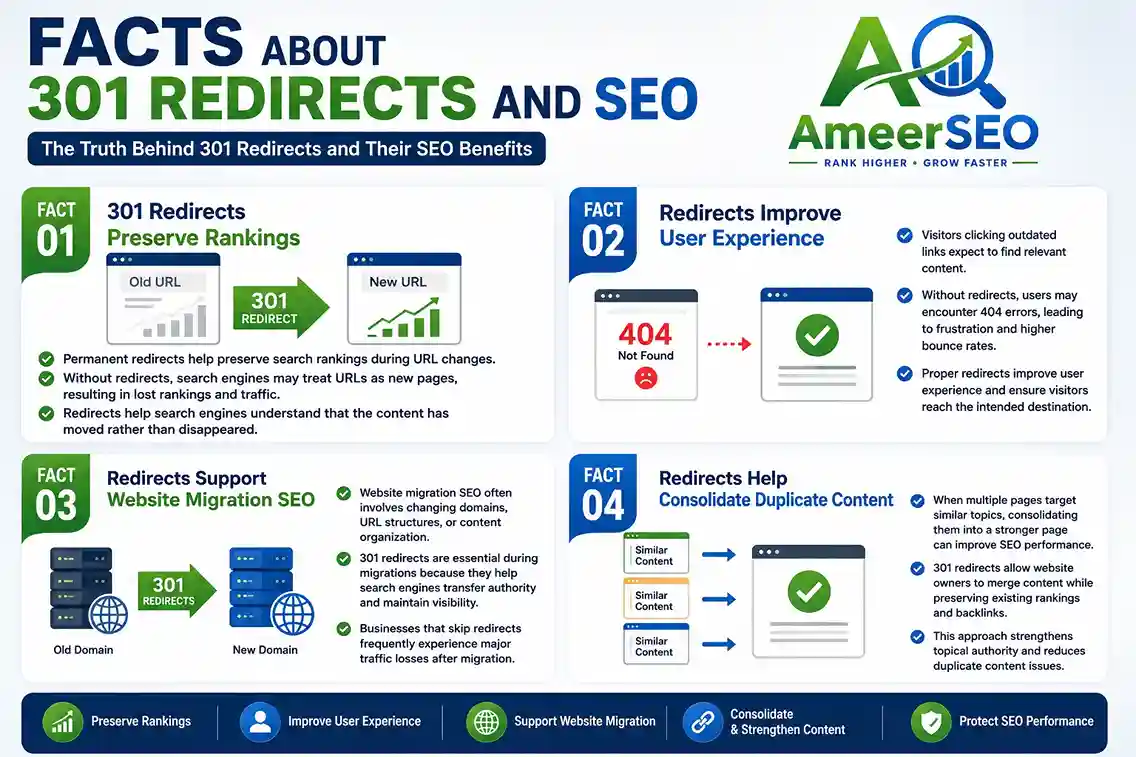
Fact #1 – 301 Redirects Preserve Rankings
One of the primary benefits of permanent redirects is preserving search rankings during URL changes.
When URLs are updated without redirects, search engines may treat them as completely new pages. This can result in lost rankings and traffic.
Redirects help search engines understand that the content has moved rather than disappeared.
Fact #2 – Redirects Improve User Experience
Visitors clicking outdated links expect to find relevant content.
Without redirects, users may encounter 404 errors, leading to frustration and higher bounce rates.
Proper redirects improve user experience and ensure visitors reach the intended destination.
Fact #3 – Redirects Support Website Migration SEO
Website migration SEO often involves changing domains, URL structures, or content organization.
301 redirects are essential during migrations because they help search engines transfer authority and maintain visibility.
Businesses that skip redirects frequently experience major traffic losses after migration.
Fact #4 – Redirects Help Consolidate Duplicate Content
When multiple pages target similar topics, consolidating them into a stronger page can improve SEO performance.
301 redirects allow website owners to merge content while preserving existing rankings and backlinks.
This approach strengthens topical authority and reduces duplicate content issues.
301 Redirect vs 302 Redirect for SEO
Many website owners confuse 301 and 302 redirects.
A 301 redirect signals a permanent move, while a 302 redirect indicates a temporary move. Search engines treat these redirects differently.
| Feature | 301 Redirect | 302 Redirect |
|---|---|---|
| Purpose | Permanent URL change | Temporary URL change |
| SEO Value Transfer | Passes ranking signals | Limited transfer in many cases |
| Indexing | Replaces old URL | Usually keeps original URL |
| Site Migration Use | Recommended | Not recommended |
| Long-Term SEO | Ideal choice | Temporary solution |
For permanent URL redirects, a 301 redirect is generally the preferred option.
Can Too Many 301 Redirects Hurt SEO?
A single redirect rarely creates problems.
However, multiple redirects chained together can create inefficiencies. For example:
Page A → Page B → Page C → Page D
This sequence creates a redirect chain that forces search engine crawlers and users to pass through several URLs before reaching the final destination.
Long redirect chains can slow crawling, affect user experience, and reduce efficiency.
The best practice is to redirect directly from the original URL to the final destination.
What Are Redirect Loops?
Redirect loops occur when pages continuously redirect back and forth.
For example:
- Page A redirects to Page B.
- Page B redirects back to Page A.
This creates an endless cycle that prevents users and search engines from accessing content.
Redirect loops can significantly impact search engine indexing and should be fixed immediately.
Best Practices for Implementing 301 Redirects
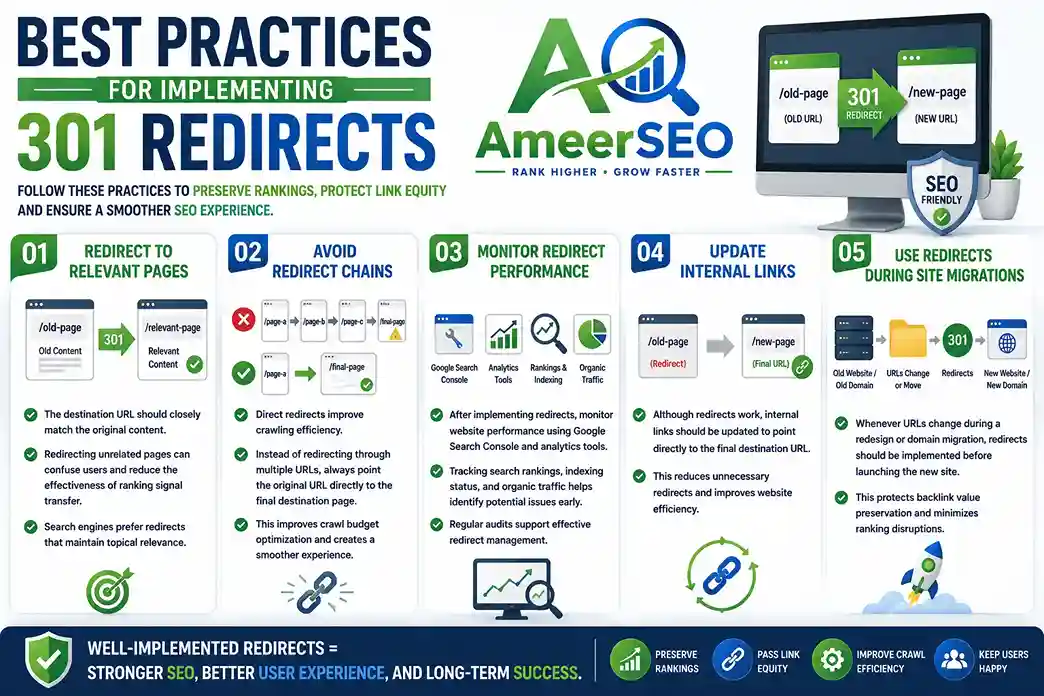
Redirect to Relevant Pages
The destination URL should closely match the original content.
Redirecting unrelated pages can confuse users and reduce the effectiveness of ranking signal transfer.
Search engines prefer redirects that maintain topical relevance.
Avoid Redirect Chains
Direct redirects improve crawling efficiency.
Instead of redirecting through multiple URLs, always point the original URL directly to the final destination page.
This improves crawl budget optimization and creates a smoother experience.
Monitor Redirect Performance
After implementing redirects, monitor website performance using Google Search Console and analytics tools.
Tracking search rankings, indexing status, and organic traffic helps identify potential issues early.
Regular audits support effective redirect management.
Update Internal Links
Although redirects work, internal links should be updated to point directly to the final destination URL.
This reduces unnecessary redirects and improves website efficiency.
Use Redirects During Site Migrations
Whenever URLs change during a redesign or domain migration, redirects should be implemented before launching the new site.
This protects backlink value preservation and minimizes ranking disruptions.
How Redirects Affect Search Engine Crawlers
Search engine crawlers use redirects to discover moved content.
When a crawler encounters a 301 redirect, it follows the destination URL and updates its index accordingly.
Proper redirects help search engine indexing processes and ensure valuable pages remain discoverable.
Poor redirect implementation can create crawling inefficiencies that affect SEO performance.
Do 301 Redirects Impact Organic Traffic?
Many businesses fear losing traffic after implementing redirects.
In reality, traffic losses are usually caused by poor redirect execution rather than the redirects themselves.
When redirects are mapped correctly and point to relevant pages, websites often maintain or recover organic traffic quickly.
For large migration projects, temporary fluctuations are normal while search engines process the changes.
How Long Does a 301 Redirect Affect SEO?
A 301 redirect remains active until removed.
Search engines continue recognizing the redirect and passing ranking signals as long as it exists.
Most SEO professionals recommend keeping important redirects active indefinitely, especially for pages with valuable backlinks.
Removing redirects prematurely can lead to lost authority and broken user pathways.
Does Google Recommend 301 Redirects?
Yes.
Google Search Central recommends using 301 redirects for permanent URL changes. They help Google understand website restructuring and preserve SEO signals during transitions.
Whether you’re changing domains, updating URL structures, or consolidating content, 301 redirects remain Google’s preferred solution.
Why Businesses Should Pay Attention to Redirect Strategy
A strong redirect strategy protects years of SEO effort.
Websites accumulate backlinks, rankings, and authority over time. Without proper redirects, these assets can disappear when URLs change.
Businesses investing in professional SEO services often prioritize redirect planning during migrations and redesigns.
Many organizations seeking a top seo expert in Pakistan understand the importance of technical SEO elements such as redirects, crawl budget optimization, and site migration planning.
Similarly, companies looking for the best seo services in Lahore frequently require redirect audits to maintain visibility during website updates.
Professionals such as Ameer SEO recognize that redirect implementation is a critical component of long-term SEO success.
Conclusion
301 redirects are not bad for SEO. In fact, they are one of the most valuable tools available for preserving rankings, transferring link equity, supporting website migration SEO, and maintaining user experience.
The myths surrounding redirects often stem from outdated practices or incorrect implementation. Modern search engines effectively process permanent redirects and use them to understand URL changes.
By avoiding redirect chains, preventing redirect loops, maintaining relevance, and following SEO best practices, website owners can leverage 301 redirects to protect and even improve search visibility over time.
FAQs
Do 301 redirects hurt SEO rankings?
No. Properly implemented 301 redirects help preserve rankings and transfer ranking signals to the new URL.
Do 301 redirects pass full link equity?
Google has indicated that modern 301 redirects effectively pass ranking signals and link equity when implemented correctly.
Can too many 301 redirects hurt SEO?
The number of redirects is not usually a problem. Issues arise when websites create long redirect chains or redirect loops.
What is the difference between a 301 and 302 redirect?
A 301 redirect is permanent, while a 302 redirect is temporary. Permanent redirects are generally preferred for SEO.
How do 301 redirects affect search engine indexing?
Search engines follow the redirect, index the destination page, and gradually replace the original URL in search results.
Are redirect chains bad for SEO?
Yes. Redirect chains can slow crawling, waste crawl budget, and create a poor user experience.
How long should I keep a 301 redirect active?
Important redirects should remain active indefinitely, especially if the original URLs have backlinks or traffic.
Should I use 301 redirects during a website migration?
Yes. Website migration SEO relies heavily on 301 redirects to preserve rankings, backlinks, and organic traffic.
Do redirects improve user experience?
Yes. Redirects ensure users reach the correct page instead of encountering broken links or 404 errors.
Does Google recommend 301 redirects?
Yes. Google recommends 301 redirects for permanent URL changes and website restructuring projects.