SEO is one of the most effective digital marketing strategies for building long-term online visibility, but it is also one of the most misunderstood. A common question businesses ask is, how long does SEO take to show results? The answer depends on several factors, including your website’s current condition, competition level, keyword difficulty, content quality, technical SEO, and backlink profile.
Unlike paid advertising, search engine optimization focuses on sustainable organic growth rather than instant visibility. Google evaluates websites based on hundreds of ranking factors, making SEO a gradual process that rewards consistency and quality.
In this guide, you’ll learn the average SEO results timeline, the factors that influence rankings, realistic expectations for new and established websites, and practical ways to improve your search engine visibility.
What Is the Typical SEO Results Timeline?
Most websites begin seeing measurable improvements within three to six months. However, reaching highly competitive positions for valuable keywords often requires six to twelve months or longer.
The SEO campaign duration varies because every website starts from a different point. A brand-new website must first earn trust and authority, while an established website may improve more quickly if it already has strong content and backlinks.
Search engines continuously crawl, index, and evaluate websites. Even after pages are indexed, Google needs time to understand content relevance, user experience, and website authority before significantly improving rankings.
General SEO Timeline
| Time Period | What to Expect |
|---|---|
| First Month | Technical SEO audit, keyword research, website optimization, indexing improvements |
| 2–3 Months | Content optimization, internal linking, crawl improvements, early keyword ranking changes |
| 3–6 Months | Growth in organic search traffic, better search visibility, stronger keyword rankings |
| 6–12 Months | Higher Google rankings, improved domain authority, consistent SEO performance |
| 12+ Months | Sustainable organic growth, increased conversions, long-term SEO success |
Why SEO Takes Time
SEO is not simply about adding keywords to a page. Google’s search engine algorithms evaluate quality, authority, relevance, user experience, and trust before rewarding a website with higher rankings.
Every page competes against thousands of other pages targeting similar search intent. Google wants to ensure users receive the most useful answer rather than the newest page.
Website authority also develops gradually. High-quality backlinks, positive engagement signals, and content freshness contribute to stronger rankings over time.
Google Needs Time to Crawl and Index
Before a page can rank, search engine crawlers must discover it through XML sitemaps, internal linking, or external backlinks.
Once crawled, the page enters Google’s indexing system. Only after indexing can Google compare it against competing pages in the Search Engine Results Pages (SERPs).
Competition Matters
Ranking for a low-competition keyword may happen relatively quickly. Highly competitive industries often require months of consistent optimization because established competitors already possess stronger backlink profiles and higher domain authority.
Factors Affecting SEO Results
Website Age
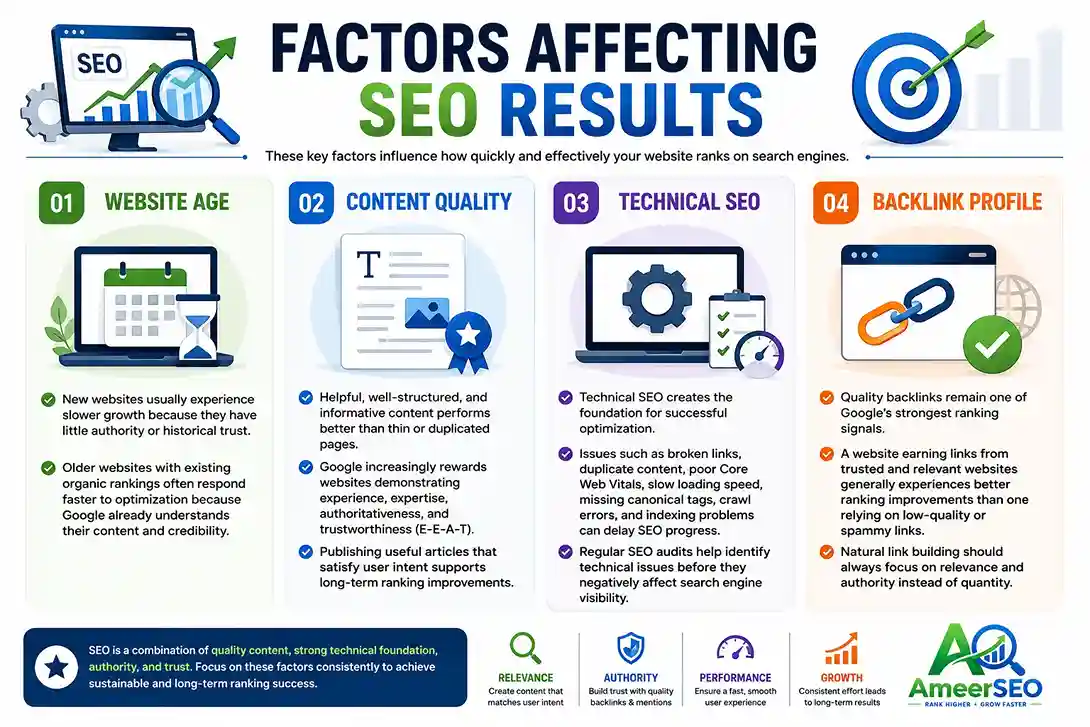
New websites usually experience slower growth because they have little authority or historical trust.
Older websites with existing organic rankings often respond faster to optimization because Google already understands their content and credibility.
Content Quality
Helpful, well-structured, and informative content performs better than thin or duplicated pages.
Google increasingly rewards websites demonstrating experience, expertise, authoritativeness, and trustworthiness (E-E-A-T). Publishing useful articles that satisfy user intent supports long-term ranking improvements.
Technical SEO
Technical SEO creates the foundation for successful optimization.
Issues such as broken links, duplicate content, poor Core Web Vitals, slow loading speed, missing canonical tags, crawl errors, and indexing problems can delay SEO progress.
Regular SEO audits help identify technical issues before they negatively affect search engine visibility.
Backlink Profile
Quality backlinks remain one of Google’s strongest ranking signals.
A website earning links from trusted and relevant websites generally experiences better ranking improvements than one relying on low-quality or spammy links.
Natural link building should always focus on relevance and authority instead of quantity.
New Website SEO Timeline vs Established Website
New Website
A new website starts with little authority and no ranking history.
The first few months usually involve keyword research, content publishing, technical optimization, Google Search Console setup, Google Analytics integration, sitemap submission, and indexing improvements.
Meaningful organic traffic often begins after several months of consistent publishing and optimization.
Existing Website
An established website already has indexed pages and historical performance data.
Improving technical SEO, refreshing outdated content, strengthening internal linking, and optimizing existing pages often produce faster results than starting from scratch.
What Happens During the First 90 Days?
First 30 Days
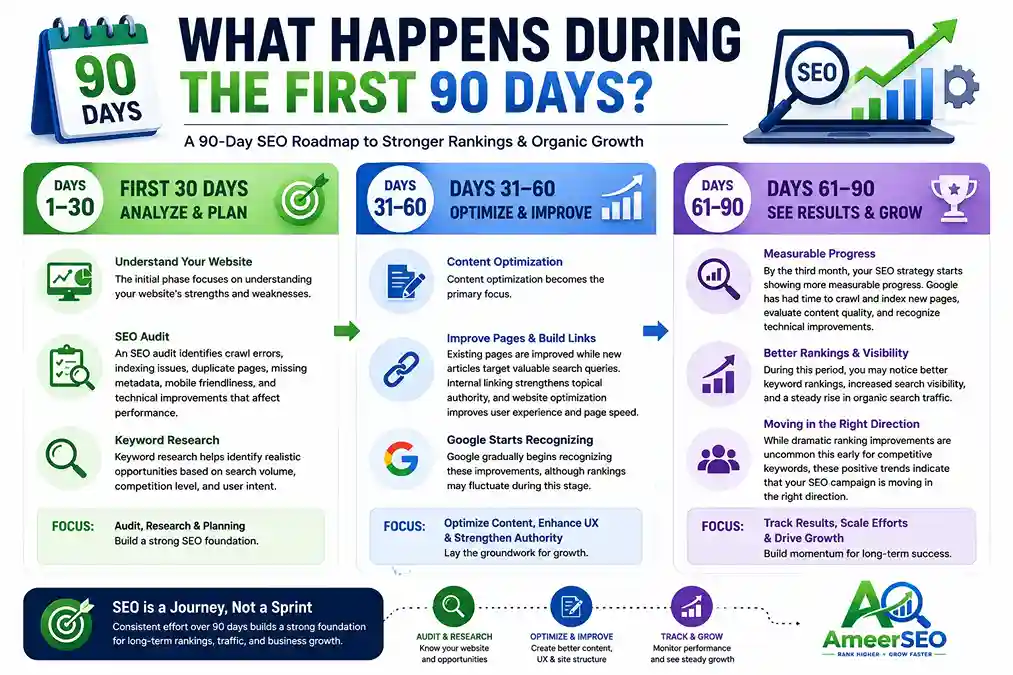
The initial phase focuses on understanding your website’s strengths and weaknesses.
An SEO audit identifies crawl errors, indexing issues, duplicate pages, missing metadata, mobile friendliness, and technical improvements that affect performance.
Keyword research helps identify realistic opportunities based on search volume, competition level, and user intent.
Days 31–60
Content optimization becomes the primary focus.
Existing pages are improved while new articles target valuable search queries. Internal linking strengthens topical authority, and website optimization improves user experience and page speed.
Google gradually begins recognizing these improvements, although rankings may fluctuate during this stage.
Days 61–90
By the third month, your SEO strategy starts showing more measurable progress. Google has had time to crawl and index new pages, evaluate content quality, and recognize technical improvements made across the website.
During this period, you may notice better keyword rankings, increased search visibility, and a steady rise in organic search traffic. While dramatic ranking improvements are uncommon this early for competitive keywords, these positive trends indicate that your SEO campaign is moving in the right direction.
How Long Does Local SEO Take?
Local SEO often produces results faster than national SEO because businesses compete within a specific geographic area rather than across an entire country.
If your Google Business Profile is fully optimized, your website targets location-specific keywords, and you consistently earn positive customer reviews, improvements in local search rankings may appear within three to four months.
Businesses serving highly competitive cities may need additional time to establish authority, build local citations, and strengthen their online reputation before consistently appearing in the Local Pack.
How Long Does E-commerce SEO Take?
E-commerce SEO typically requires more time because online stores contain hundreds or even thousands of product and category pages.
Optimizing product descriptions, improving internal linking, fixing technical SEO issues, and creating helpful buying guides all contribute to stronger website SEO performance. Most online stores begin seeing meaningful organic growth within six to twelve months when optimization is performed consistently.
Common Reasons SEO Takes Longer Than Expected
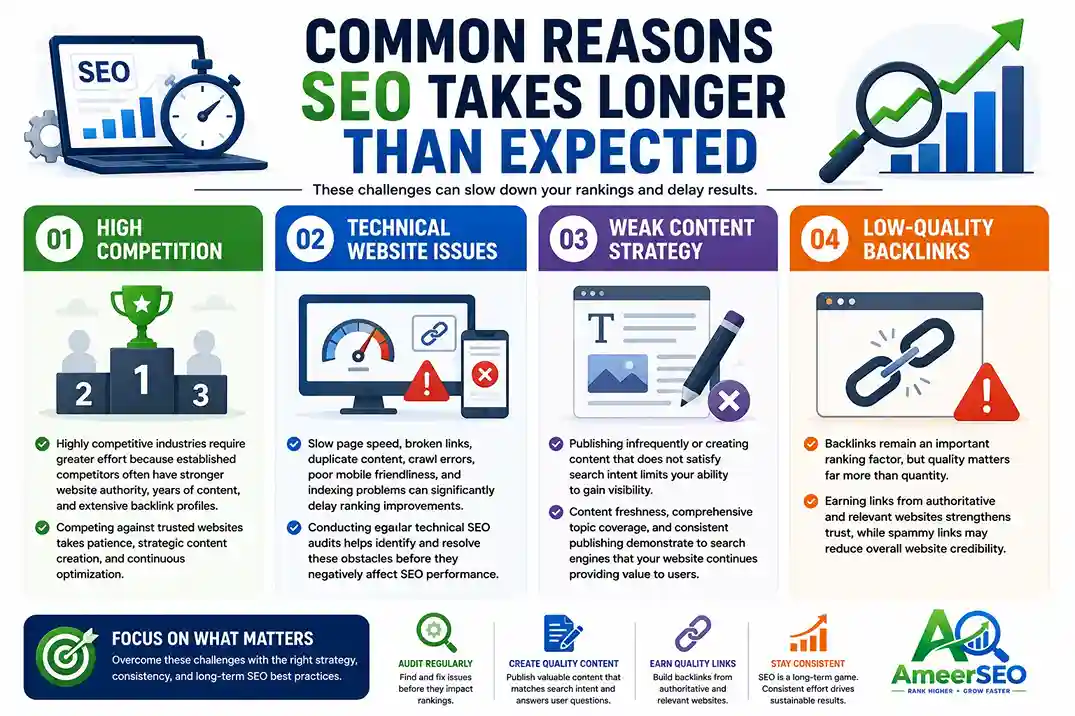
High Competition
Highly competitive industries require greater effort because established competitors often have stronger website authority, years of content, and extensive backlink profiles.
Competing against trusted websites takes patience, strategic content creation, and continuous optimization.
Technical Website Issues
Slow page speed, broken links, duplicate content, crawl errors, poor mobile friendliness, and indexing problems can significantly delay ranking improvements.
Conducting regular technical SEO audits helps identify and resolve these obstacles before they negatively affect SEO performance.
Weak Content Strategy
Publishing infrequently or creating content that does not satisfy search intent limits your ability to gain visibility.
Content freshness, comprehensive topic coverage, and consistent publishing demonstrate to search engines that your website continues providing value to users.
Low-Quality Backlinks
Backlinks remain an important ranking factor, but quality matters far more than quantity.
Earning links from authoritative and relevant websites strengthens trust, while spammy links may reduce overall website credibility.
How to Speed Up SEO Results
Although SEO cannot be rushed, several best practices can accelerate progress without violating search engine guidelines.
Start by conducting a complete SEO audit to uncover technical problems affecting crawlability and indexing. Improve website speed, optimize Core Web Vitals, and ensure every important page is mobile-friendly.
Create high-quality content that directly answers user questions and satisfies search intent. Strengthen internal linking so search engine crawlers can easily discover related pages throughout your website.
Focus on natural link building through valuable resources, industry partnerships, and shareable content instead of purchasing backlinks.
Monitor your SEO progress regularly using Google Search Console and Google Analytics. These tools provide valuable insights into impressions, clicks, indexing status, keyword rankings, and overall website optimization performance.
Signs Your SEO Is Working
SEO success is measured by more than reaching the first page of Google.
One of the earliest indicators is increased search visibility. Even if rankings fluctuate, more impressions suggest Google is displaying your pages for relevant searches.
Growth in organic traffic, improved keyword rankings, longer user engagement, higher click-through rates, and increased conversions all indicate your optimization efforts are producing positive results.
As website authority grows, ranking improvements generally become more stable, allowing your pages to compete for increasingly valuable search terms.
SEO Timeline Comparison
| SEO Factor | Faster Results | Slower Results |
|---|---|---|
| Website Age | Established websites | Brand-new websites |
| Competition | Low competition | High competition |
| Keyword Difficulty | Long-tail keywords | Highly competitive keywords |
| Technical SEO | Fully optimized website | Technical issues remain unresolved |
| Content | High-quality, helpful content | Thin or duplicate content |
| Backlinks | Strong, authoritative links | Weak or spammy link profile |
| Publishing Frequency | Consistent updates | Infrequent publishing |
| User Experience | Fast, mobile-friendly website | Poor Core Web Vitals and usability |
Should You Invest in SEO for Long-Term Growth?
SEO is one of the few digital marketing strategies that continues delivering value long after content is published. Unlike paid advertising, which stops generating traffic when your budget ends, organic rankings can continue attracting qualified visitors for months or even years.
Businesses looking for affordable SEO services in Pakistan should focus on long-term strategies rather than quick fixes. Sustainable optimization builds trust with search engines and creates a stronger foundation for future growth.
If you are searching for a top-rated SEO service in Islamabad, choose an agency that emphasizes technical SEO, content optimization, ethical link building, and transparent reporting instead of unrealistic promises.
At Ameer SEO, the focus is on implementing data-driven strategies that improve search visibility while supporting steady, long-term business growth.
Frequently Asked Questions
How long does SEO take to show results?
Most websites begin seeing measurable improvements within three to six months. Highly competitive industries may require six to twelve months or longer to achieve significant Google rankings.
Can SEO work in one month?
Some technical improvements may appear within the first month, but meaningful increases in organic traffic and keyword rankings generally require consistent optimization over several months.
Does SEO take three to six months?
Yes. For many businesses, three to six months is a realistic timeframe to notice improvements in search visibility, indexing, and organic search traffic, provided a comprehensive SEO strategy is followed.
Why are my rankings fluctuating?
Ranking fluctuations are normal because Google frequently updates its search engine algorithms and continuously reevaluates pages based on relevance, competition, and user behavior.
How long does local SEO take?
Local SEO campaigns often show noticeable improvements within three to four months, although competition and website authority can influence the timeline.
How long does e-commerce SEO take?
E-commerce websites usually require six to twelve months to build authority, optimize large product catalogs, and generate sustainable organic growth.
How can I speed up SEO results?
You can improve SEO progress by fixing technical issues, publishing valuable content regularly, strengthening internal linking, earning high-quality backlinks, and monitoring performance through Google Search Console and Google Analytics.
Is SEO worth the investment?
Yes. SEO provides long-term visibility, qualified organic traffic, improved brand credibility, and a higher return on investment compared to many short-term marketing channels when implemented consistently.
Conclusion
So, how long does SEO take to show results? While there is no universal timeline, most businesses can expect meaningful progress within three to six months and stronger long-term growth over six to twelve months. The exact timeframe depends on factors such as website age, competition level, technical SEO, content quality, backlink profile, and overall website authority.
SEO is a continuous process rather than a one-time project. By focusing on high-quality content, technical excellence, user experience, and ethical optimization practices, you create a website that earns trust from both search engines and users. Consistency, patience, and regular performance monitoring remain the keys to achieving lasting organic success.