
What Are SEO Tools? Operator’s Guide to Ranking Without Wasting Budget
What Are SEO Tools?
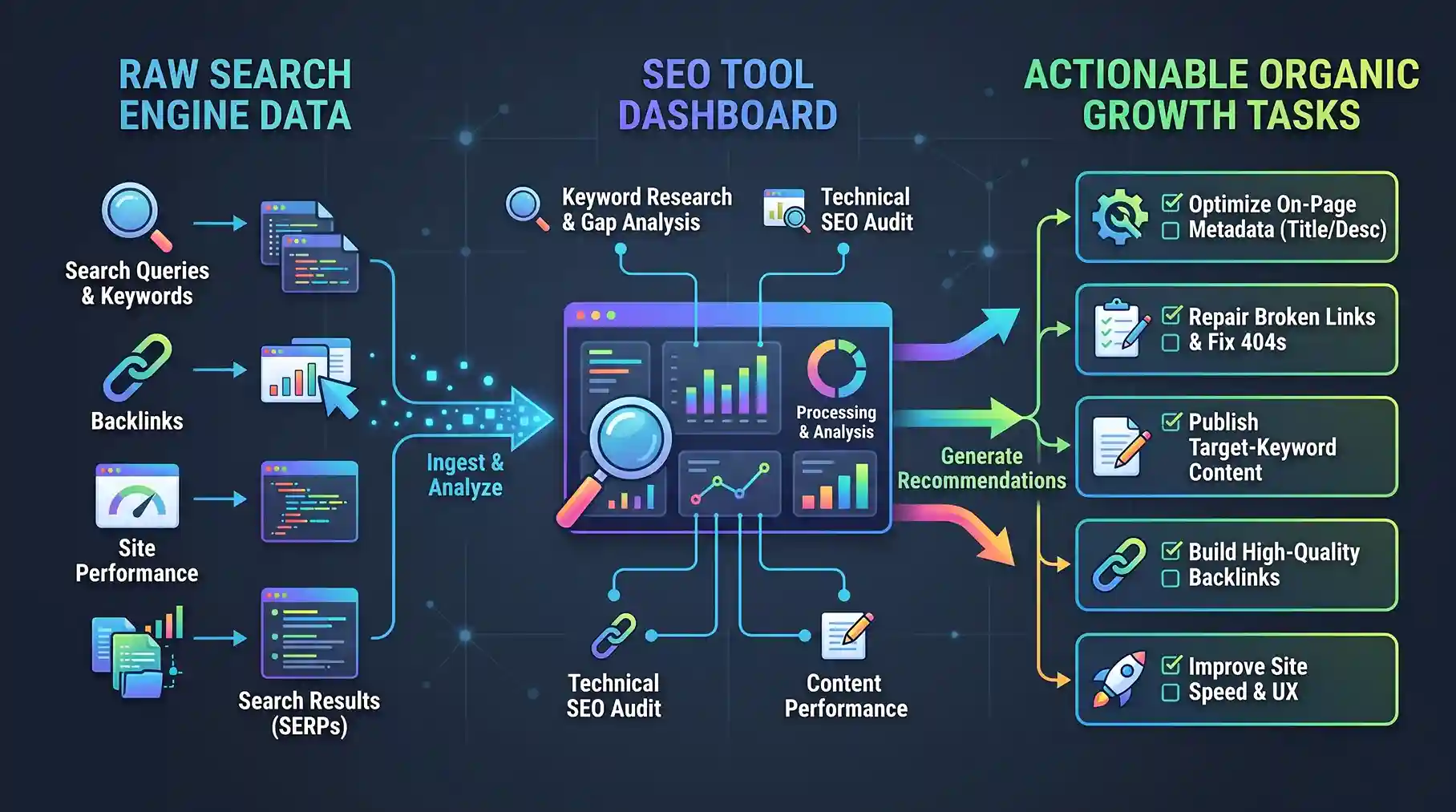
SEO tools are specialized software applications that analyze how search engines crawl, index, and rank web pages. They provide structured diagnostic data on search demand, keyword competitiveness, technical errors, and backlink profiles, allowing operators to diagnose visibility bottlenecks and capture organic search demand efficiently.
For a small business owner, these platforms replace guesswork. Instead of writing blog posts hoping they match search intent, software pinpoints the exact phrases potential buyers query and the technical barriers blocking conversions.
Every production-grade SEO stack addresses four distinct operational layers:
-
Discovery & Demand: Uncovering high-intent search queries and monthly volume metrics.
-
Technical Infrastructure: Identifying site architecture failures, slow page speeds, and indexing blocks.
-
Competitive Intelligence: Deconstructing where competitors acquire authoritative links and market share.
-
Performance Telemetry: Tracking live rank positions, crawl frequency, and conversion attribution.
The Agency Reality Check: Why Software Subscriptions Don’t Rank Websites
Tool vendors market their suites as all-in-one growth engines. In client accounts, we frequently audit dashboards packed with enterprise subscriptions where organic revenue remains completely stagnant.
Software provides diagnostic measurements, not strategic execution. Knowing a competitor holds 450 referring domains does not earn links, and receiving a crawl health score of 92 does not guarantee top-three placement on commercial search queries.
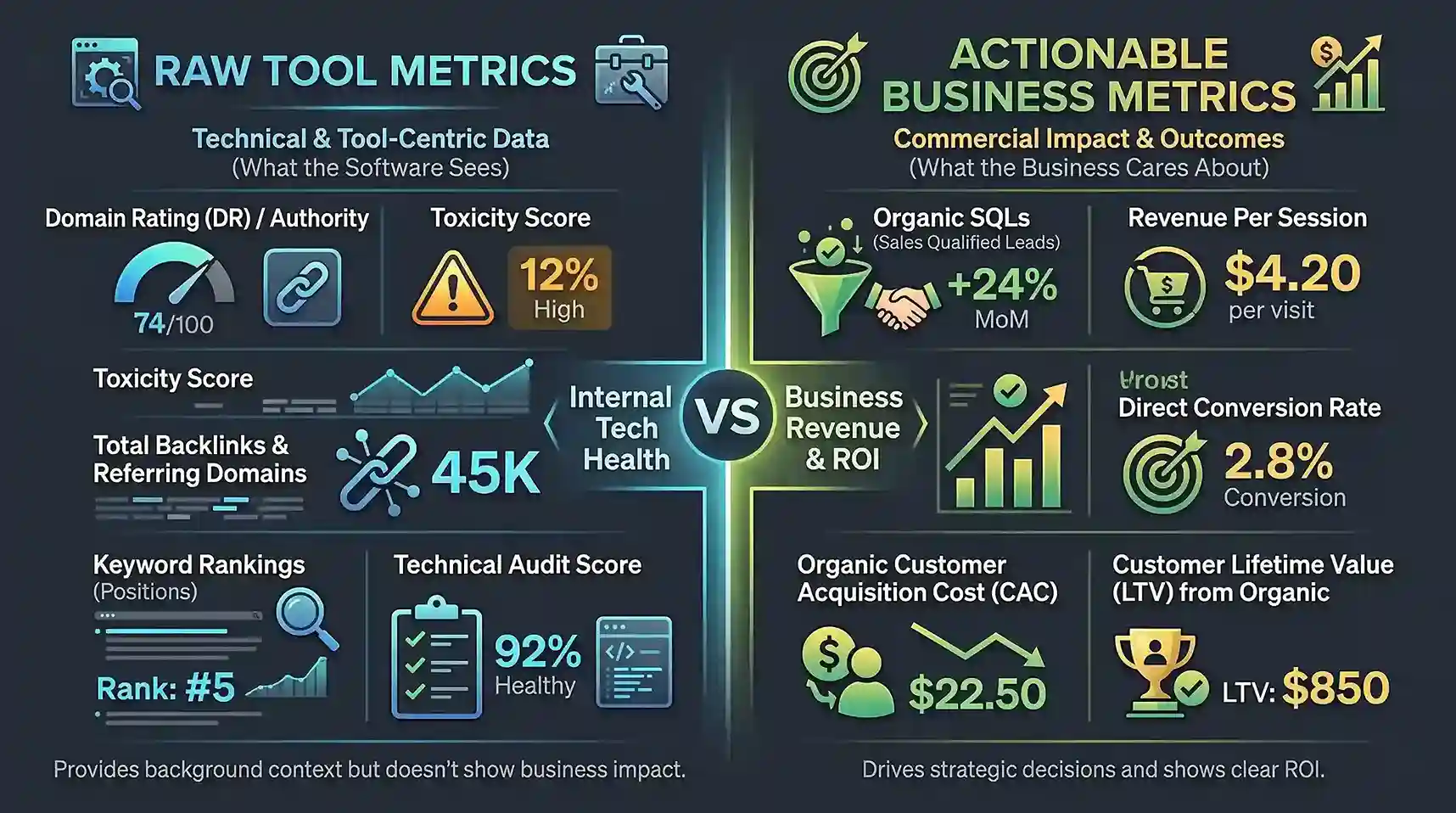
Treat platforms as diagnostic instruments. A mechanic’s diagnostic reader does not rebuild a transmission; it simply isolates where torque is lost.
The 4 Core Tool Categories Every Small Business Must Master
Managing live search campaigns requires dividing your stack into dedicated operational functions rather than paying for redundant feature sets.
1. Technical Health & Crawlability
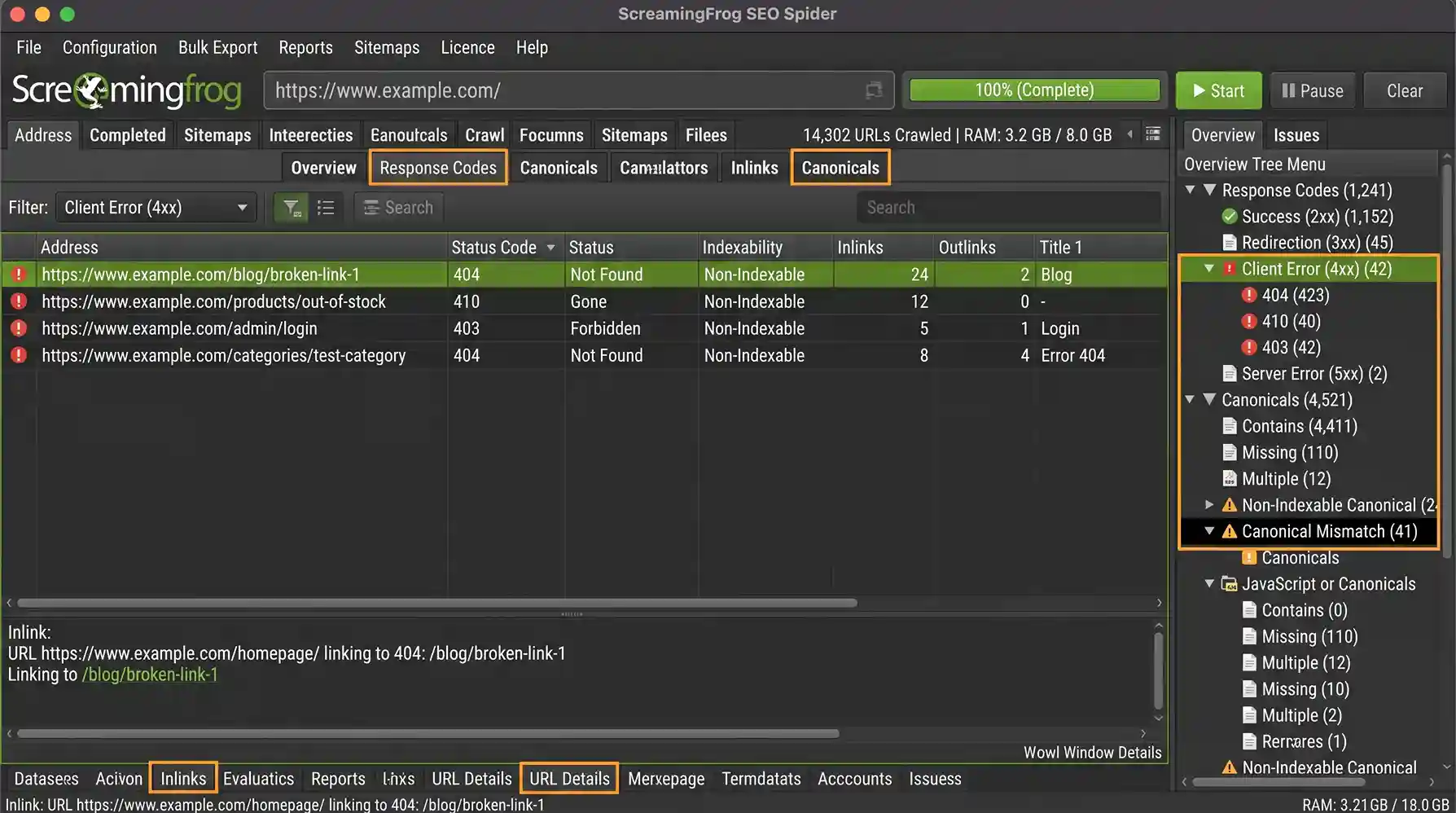
Technical tools simulate search engine crawlers (such as Googlebot) to parse your internal link graphs, status codes, and server performance.
-
Core Utility: Surfaces broken links (404s), broken redirects (301 loops), missing canonical tags, and unindexed URLs.
-
Why It Matters: Search engines allocate limited crawl budgets to small websites. If your architecture traps crawlers in infinite loops or serves slow pages, high-value commercial pages never make the index.
-
Primary Metric to Track: Valid Indexed Pages in Google Search Console vs. Total Submitted URLs.
2. Keyword Research & Search Intent Mapping
These databases aggregate clickstream data and search engine results page (SERP) results to reveal consumer demand patterns.
-
Core Utility: Filters queries by search volume, click-through probability, and keyword difficulty (KD).
-
Agency Perspective: Ignore high-volume, generic informational head terms. Lean businesses win by targeting zero-volume and low-difficulty commercial queries that indicate immediate purchase intent.
-
Primary Metric to Track: Cost-Per-Click (CPC) equivalence and Search Intent alignment (Informational vs. Commercial/Transactional).
3. On-Page Optimization & Content Analysis
On-page software grades copy against top-ranking competitors by calculating semantic keyword density, heading distribution, and entity coverage.
-
Core Utility: Guides content updates by suggesting related entities, question variants, and reading structure.
-
The Trade-Off: Chasing an arbitrary “100/100” optimization score frequently causes keyword stuffing, hurting user engagement metrics and conversion rates.
-
Primary Metric to Track: Average Time on Page and Assisted Conversion Rate.
4. Backlink Intelligence & Competitor Benchmarking
Backlink tools index the internet’s hyperlink graph to show which third-party domains endorse your digital property.
-
Core Utility: Uncovers toxic inbound spam, identifies link reclamation opportunities, and reveals competitor outreach playbooks.
-
The Reality: Proprietary metrics like Domain Authority (DA) or Domain Rating (DR) are third-party approximations. Google does not use third-party authority scores in its ranking algorithms; it evaluates contextual relevance and link trust.
-
Primary Metric to Track: Total Unique Referring Domains from contextually relevant, indexable publications.
Comparative Stack Analysis: Free Essentials vs. Paid Suites
Small businesses often waste $1,000 to $3,000 annually on software features they never open. Review how entry-level and enterprise stacks compare for lean teams:
| Tool / Platform | Category | Monthly Cost | Primary Strength | Agency Verdict |
| Google Search Console | Performance / Technical | Free | 100% first-party Google ranking & indexing data | Mandatory. The single source of ground truth for indexing status. |
| Google Analytics 4 | Web Analytics | Free | Tracks behavioral conversion pathways and revenue | Mandatory. Essential for connecting organic sessions to bottom-line pipeline. |
| Screaming Frog SEO Spider | Site Architecture Audit | Free (up to 500 URLs) | Exhaustive client-side and server-side technical audits | Essential. The industry standard for auditing small business architectures. |
| Ahrefs / Semrush | All-in-One Growth Suite | $129 – $149/mo | Deep competitor backlink graphs and intent volumes | Situational. High utility, but only justified once you produce consistent content weekly. |
| Google Keyword Planner | Demand Forecasting | Free | Actual ad bid pricing and commercial search interest | Underutilized. Best tool for uncovering transactional buyer intent without monthly fees. |
The 4-Step Lean Workflow for Small Business Owners
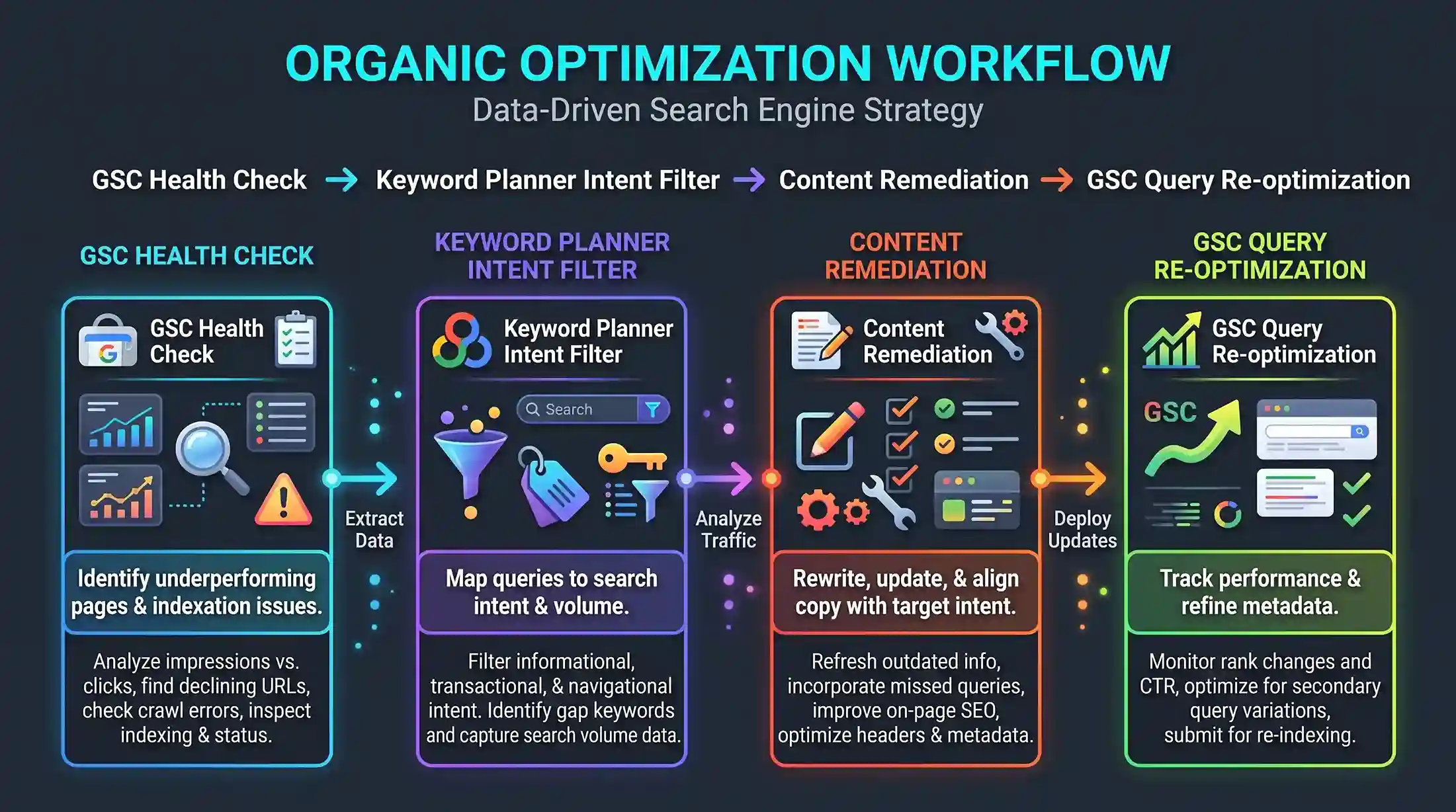
If you have under 5 hours per week to invest in organic search, follow this sequential execution model using free and low-cost tools.
-
Verify Indexation in Google Search Console
Navigate to the Pages report. Review non-indexed pages and isolate issues labeled “Discovered – currently not indexed” or “Crawled – currently not indexed.” Resolve server timeouts, low-value thin pages, or internal canonical conflicts before publishing new content.
-
Isolate High-Intent Commercial Keywords
Use Google Keyword Planner or entry-level research databases to identify terms featuring explicit purchase modifiers (e.g., “near me”, “cost”, “commercial service”, “contractor”). Prioritize queries with high commercial bid values over raw search volume.
-
Deploy Local & Contextual On-Page Enhancements
Align the page title tag, H1 heading, and meta description with the target intent. Implement structured schema markup (LocalBusiness or Service schema) using free generators to help search engine parsers categorize your location and offering.
-
Monitor Striking-Distance Opportunities
Filter your Search Console performance report for queries holding positions 8 through 20. These terms sit on the verge of page-one visibility. Update the target URLs with revised answers, internal links from complementary blog posts, and refreshed media to push them into top-tier click territory.
3 Critical Traps That Drain SMB Marketing Budgets
1. Obsessing Over Proprietary “Authority” Scores
Third-party metrics like “Domain Authority” fluctuate independently of your actual organic traffic. Focus on commercial conversions, qualified sales leads (SQLs), and first-page visibility for transactional search terms rather than vanity vendor scores.
2. Paying for Enterprise Keyword Trackers Too Early
Small local businesses often purchase enterprise rank-tracking add-ons that check rankings daily across 500 keywords. Search engines evaluate algorithmic adjustments gradually; tracking daily volatility on low-volume terms provides zero strategic leverage.
3. Buying Automated “AI Optimization” Without Expert Review
Automated tools claiming to generate and push hundreds of keyword-targeted articles create programmatic low-value content. Search engines actively penalize unverified, low-information-gain pages that lack firsthand experience and technical accuracy.
Turn Raw Tool Diagnostics Into Measurable Pipeline
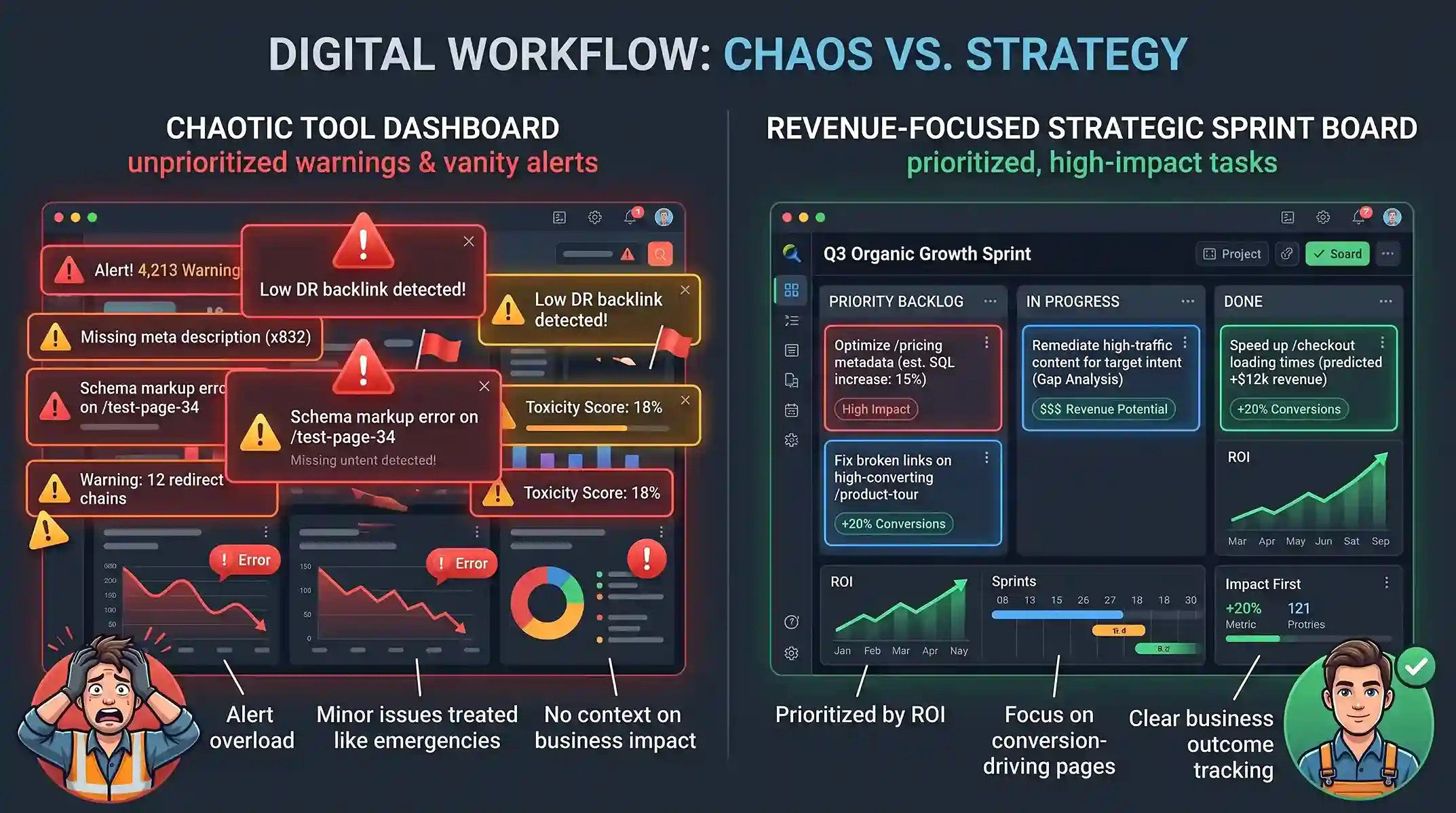
SEO software identifies where friction exists, but turning technical data into qualified customer acquisition requires rigorous prioritization and operational execution.
If you manage a business, your hours are best spent serving clients, improving operations, and closing pipeline—not deciphering crawler logs, server response codes, and algorithmic updates.
Skip the monthly tool bloat and see where your highest-leverage growth opportunities live. Claim Your Free Audit Now to receive a customized diagnostic review of your website’s indexing health, organic search footprint, and competitive growth opportunities.