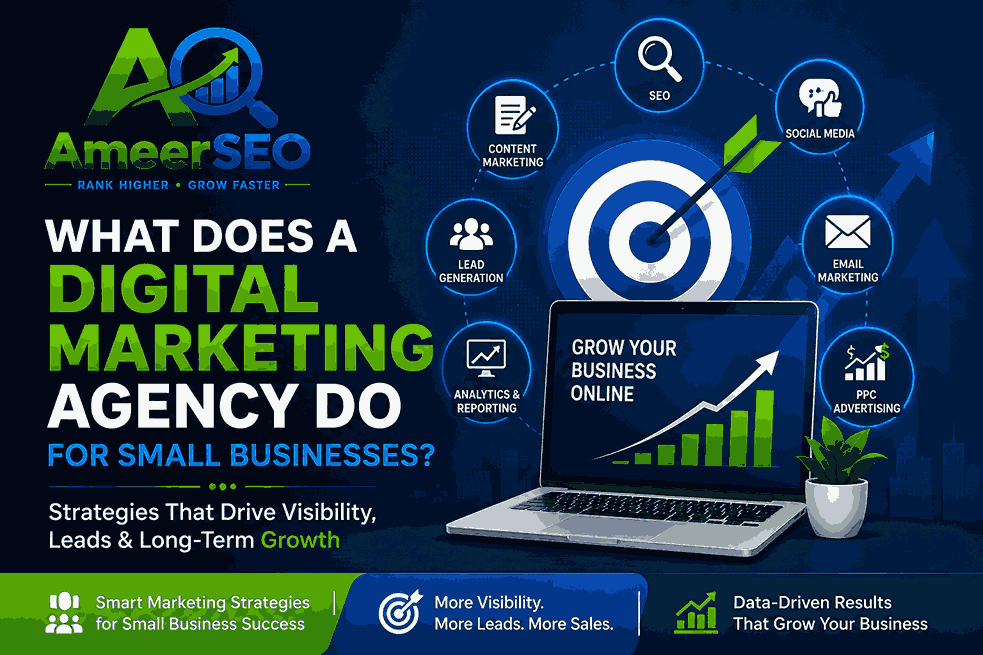
Small businesses need a strong online presence to compete with larger companies, attract new customers, and build lasting brand recognition. A digital marketing agency can help small businesses create effective online marketing strategies that increase visibility, generate leads, and support long-term growth.
A digital marketing agency combines services such as SEO, social media marketing, content marketing, paid advertising, email marketing, and conversion optimization. Instead of managing every marketing channel independently, small businesses can work with Ameer SEO to develop a coordinated digital marketing strategy based on their goals and target audience.
Choosing the best digital marketing agency in Pakistan can also help businesses make better use of their marketing budget. Agencies use keyword research, competitor analysis, marketing analytics, and campaign optimization to identify opportunities and focus resources on activities that can generate measurable results.
What Is a Digital Marketing Agency?
A digital marketing agency is a company that helps businesses promote their products or services through online channels. Its role can include developing marketing strategies, improving search engine rankings, managing advertising campaigns, creating content, and increasing customer engagement.
Rather than relying only on traditional advertising, businesses can use digital channels to reach specific audiences at different stages of the customer journey. This makes online marketing particularly useful for small businesses that need cost-effective ways to compete in their markets.
What Does a Digital Marketing Agency Do for Small Businesses?
A digital marketing agency evaluates a business’s current online presence and identifies opportunities for improvement. It may analyze the website, search rankings, competitors, social media profiles, advertising performance, and customer acquisition process.
The agency then develops a marketing strategy around the company’s goals. Depending on the business, this could focus on increasing website traffic, generating qualified leads, improving local search visibility, increasing online sales, or building brand awareness.
Search Engine Optimization for Small Businesses
Search engine optimization helps small businesses improve their visibility in organic search results. An agency can conduct keyword research, optimize website content, improve technical SEO, build relevant backlinks, and strengthen the site’s overall topical relevance.
A strong SEO strategy can help a business attract people who are already searching for its products or services. Over time, improved search engine rankings can increase organic traffic and create additional opportunities for customer acquisition.
Local SEO and Online Visibility
Local SEO is especially valuable for businesses that serve specific cities, neighborhoods, or geographic areas. Agencies can optimize Google Business Profiles, local landing pages, business information, citations, and other signals that support local search visibility.
For example, a local service provider may want to appear when potential customers search for services near them. Improving local SEO can help connect the business with customers who have strong purchase intent.
Social Media Marketing
Social media marketing helps small businesses build relationships with their target audience on platforms where potential customers spend time. An agency can develop content strategies, manage social profiles, create campaigns, and monitor audience engagement.
Social media can support several marketing goals, including brand awareness, customer engagement, website traffic, and lead generation. Consistent content also gives customers more opportunities to recognize and interact with a business.
Content Marketing
Content marketing involves creating useful and relevant material that answers customer questions and supports the buying journey. This can include blog articles, service pages, guides, educational resources, videos, and other forms of content.
For small businesses, quality content can establish expertise while supporting SEO. When content addresses genuine customer problems and search intent, it can attract organic traffic and help potential customers understand why a company’s products or services are valuable.
Pay-Per-Click Advertising
Pay-per-click advertising allows businesses to reach potential customers through paid search and display campaigns. Google Ads is one common example, where businesses can bid on keywords relevant to their products or services.
A digital marketing agency can manage campaign structures, keyword targeting, advertisements, budgets, landing pages, and performance data. Continuous campaign optimization can help businesses improve their advertising efficiency and focus on higher-value opportunities.
Website Marketing and Conversion Optimization
Getting visitors to a website is only part of digital marketing. A website also needs to make it easy for visitors to understand the business, find information, and take the desired action.
Agencies may review website design, page structure, calls to action, forms, navigation, loading performance, and landing pages. Conversion rate optimization can help turn a greater proportion of existing visitors into leads, inquiries, or customers.
Lead Generation for Small Businesses
Lead generation focuses on attracting potential customers and encouraging them to contact or engage with a business. Agencies can use SEO, paid advertising, landing pages, social media, content, and other digital channels to support lead generation.
The objective is not simply to generate a high number of leads. Effective marketing focuses on attracting qualified leads that are more likely to become paying customers.
Email Marketing and Customer Retention
Email marketing allows businesses to communicate directly with existing customers and prospects. Agencies can help develop campaigns for promotions, newsletters, product updates, follow-ups, and customer retention.
Email marketing can also support audience segmentation and marketing automation. By sending relevant messages to appropriate customer groups, businesses can maintain relationships and encourage repeat purchases.
Competitor Analysis
Understanding competitors is an important part of digital marketing strategy. Agencies can examine competitor websites, keywords, content, backlinks, advertising approaches, and online positioning.
This research can reveal gaps and opportunities. A small business may discover topics competitors have not covered, keywords they are overlooking, or ways to differentiate its services and value proposition.
Marketing Analytics and Performance Tracking
Digital marketing agencies use analytics to understand how campaigns perform. Important measurements can include website traffic, search rankings, leads, conversions, advertising costs, engagement, and revenue-related metrics.
Performance tracking allows businesses to make decisions based on data rather than assumptions. Agencies can identify underperforming campaigns, improve successful strategies, and adjust marketing activities as customer behavior changes.
How Digital Marketing Helps Small Businesses Grow
Digital marketing can help small businesses become more visible to their target audience without requiring the same advertising resources as large corporations. A combination of organic and paid strategies can create multiple channels for attracting customers.
It can also improve the customer journey from discovery to purchase. Someone may discover a business through Google, read its content, visit its social media profile, and eventually contact the company after developing confidence in its expertise.
Why Should a Small Business Hire a Digital Marketing Agency?
Managing every aspect of online marketing internally can require significant time, expertise, and resources. An agency provides access to specialists who understand SEO, advertising, content, analytics, social media, and other digital marketing disciplines.
Working with an agency can also provide a structured approach to marketing campaign management. Instead of making disconnected promotional efforts, the business can work toward clearly defined marketing goals and measurable outcomes.
How Much Does Digital Marketing Cost for a Small Business?
Digital marketing costs vary depending on the business, industry, target market, competition, services required, and advertising budget. A local business with a focused SEO campaign may have different requirements from an e-commerce company targeting customers across multiple regions.
A professional agency should evaluate the business objectives and create a strategy appropriate for its available resources. The focus should be on potential return on investment rather than simply choosing the cheapest marketing package.
How to Choose a Digital Marketing Agency
Small businesses should evaluate an agency’s experience, services, communication process, strategic approach, and ability to demonstrate measurable results. It is also important to understand exactly what activities are included in the proposed marketing campaign.
The right agency should take time to understand the business, its customers, competitors, goals, and challenges. A customized strategy is generally more useful than applying the same marketing approach to every business.
Digital Marketing Strategy for Small Businesses
An effective digital marketing strategy begins with clear goals. The business should determine whether it primarily wants more leads, sales, website traffic, local visibility, brand awareness, or customer retention.
After establishing goals, the agency can identify the target audience, research relevant keywords, analyze competitors, select appropriate channels, create content, launch campaigns, and track results. The strategy should then be continuously refined based on performance data.
Benefits of Digital Marketing for Small Businesses
Digital marketing gives small businesses opportunities to reach highly targeted audiences and measure campaign performance. Unlike many traditional marketing methods, online campaigns can provide detailed information about where visitors come from and how they interact with a business.
Another major benefit is flexibility. Businesses can adjust content, advertising budgets, targeting, and marketing strategies based on changing market conditions and performance results.
Frequently Asked Questions
A digital marketing agency may provide SEO, local SEO, social media marketing, content marketing, email marketing, PPC advertising, website marketing, lead generation, conversion rate optimization, reputation management, and analytics.
An agency helps small businesses improve online visibility, attract relevant website traffic, generate qualified leads, reach potential customers, and measure marketing performance. The exact strategy depends on the company's goals and target audience.
Yes, digital marketing can be valuable for small businesses because it provides opportunities to reach targeted audiences and measure results. The effectiveness depends on having the right strategy, consistent execution, and realistic goals.
The timeframe depends on the marketing channel. SEO often requires several months to produce significant organic growth, while paid advertising can generate traffic more quickly. Sustainable results generally require continuous optimization.
There is no universal answer. SEO can build long-term organic visibility, while paid advertising can provide faster exposure. Many businesses benefit from combining both approaches according to their budget, competition, and objectives.
Digital marketing can contribute to increased sales by improving visibility, attracting qualified prospects, strengthening customer engagement, and optimizing conversions. However, sales also depend on factors such as pricing, product quality, customer service, and market demand.
Businesses can measure success using metrics such as organic traffic, rankings, leads, conversion rates, advertising costs, engagement, customer acquisition costs, and revenue. The most important metrics should align with the company's specific goals.
Final Thoughts
A digital marketing agency can become an important growth partner for a small business. From SEO and local search visibility to social media, content marketing, paid advertising, and conversion optimization, agencies can coordinate multiple channels around a common strategy.
The most effective approach is not simply to use every available marketing channel. Instead, small businesses should identify their audience, establish measurable goals, select the channels that fit their customers, and continuously optimize campaigns based on reliable performance data.