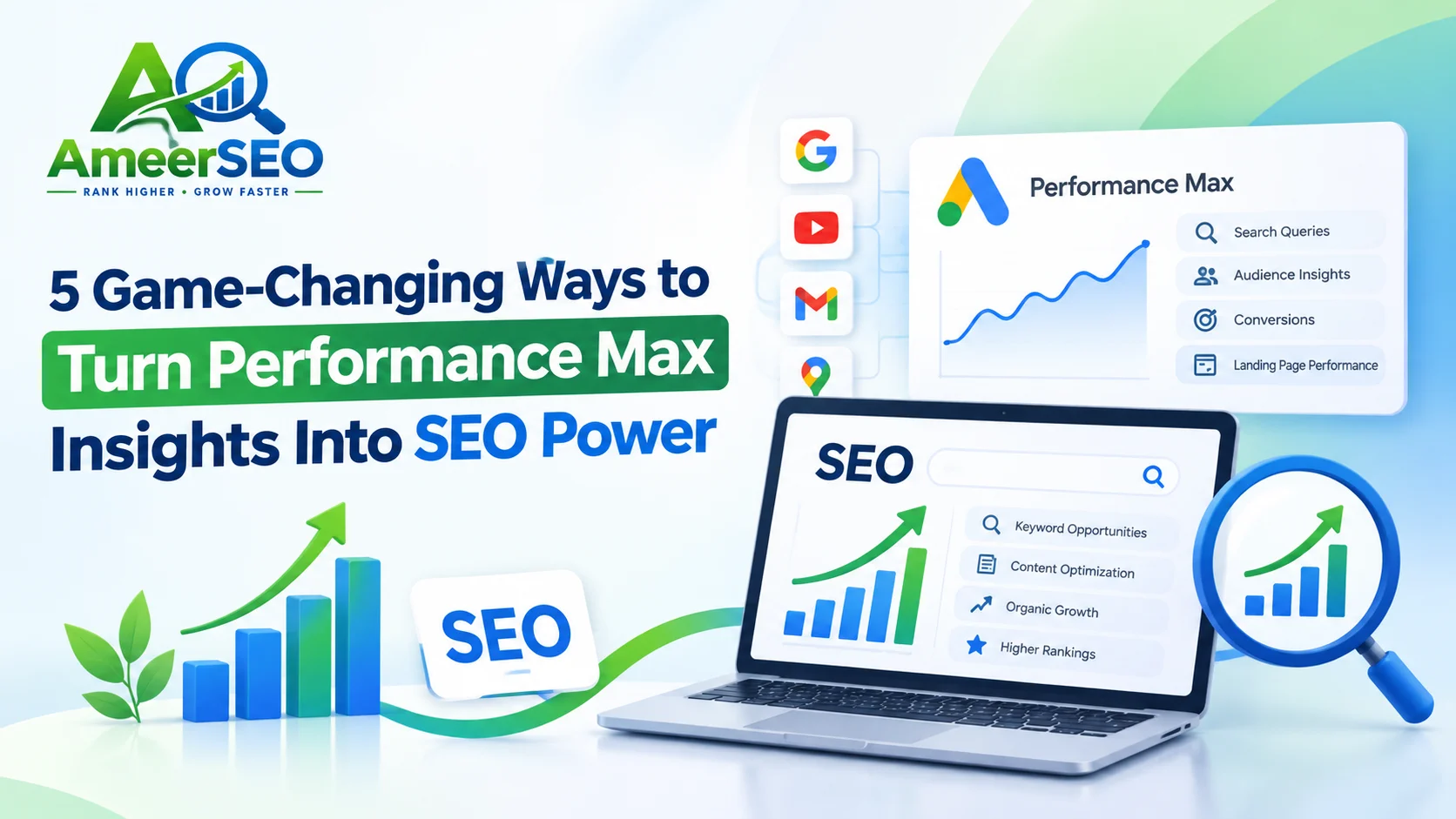
Google Performance Max campaigns generate valuable information about search behavior, conversions, audiences, and landing page performance. While this data is primarily used for paid advertising, it can also uncover opportunities for a stronger organic search strategy.
By analyzing Performance Max insights for SEO, marketers can identify high-value keywords, understand search intent, improve content, and discover pages with organic growth potential. This creates a data-driven SEO strategy that connects paid and organic search efforts.
Ameer SEO recommends looking beyond traditional PPC reporting and examining how Performance Max data can support keyword research, content optimization, and organic conversion optimization. Here are five practical ways to turn PMax insights into SEO power.
1. Discover High-Value Keywords From Performance Max Data
One of the most useful applications of Performance Max data for SEO is discovering valuable search terms. PMax campaigns can reveal queries and themes associated with clicks, conversions, and conversion value.
Instead of focusing only on search volume, analyze which keywords and search queries generate meaningful business results. High-converting keywords can become valuable targets for organic search campaigns.
Keyword performance analysis can help identify terms that deserve dedicated landing pages, supporting content, or improvements to existing pages. This approach helps prioritize SEO opportunities based on actual user behavior.
Identify High-Converting Search Terms
Search term performance can provide insights into what potential customers are actively looking for. When particular queries repeatedly contribute to conversions, they may represent strong commercial or transactional search intent.
These terms can be incorporated naturally into page titles, headings, body content, FAQs, and supporting content where relevant. The objective is not keyword stuffing but creating pages that satisfy the intent behind valuable searches.
2. Use Search Intent Data to Improve Content Strategy
Performance Max insights can reveal patterns in customer search behavior. These patterns can help businesses understand whether users are looking for information, comparing solutions, researching products, or preparing to make a purchase.
Search intent analysis is essential because ranking for a keyword is not enough. Content needs to provide the type of information users expect when they enter a particular query.
For example, informational searches may require educational guides, while commercial searches may benefit from comparison pages, service explanations, case studies, or detailed product information.
Align Content With User Search Behavior
Analyzing search intent data alongside existing organic performance can reveal content optimization opportunities. A page receiving organic impressions but failing to generate engagement may not fully satisfy the intent behind its target queries.
PMax search insights can provide another perspective on what users expect from a page. Combining paid search insights with organic search data can help create a more comprehensive content strategy.
3. Find Organic Growth Opportunities From Landing Page Data
Landing page performance is another valuable source of SEO insights. Performance Max campaigns can show which pages attract visitors and contribute to conversions.
Pages that perform well through paid traffic may contain topics, products, services, or value propositions that users find highly relevant. These pages can be evaluated for organic search opportunities.
Look at the page’s existing keyword visibility, organic traffic, backlinks, content quality, internal links, and technical SEO. A page that already converts paid visitors may have significant potential for organic growth when properly optimized.
Optimize High-Performing Landing Pages
Landing page optimization should consider both users and search engines. Review the page structure, search intent alignment, topical depth, headings, metadata, internal linking, and overall user experience.
If Performance Max data identifies a page as commercially valuable, improving its organic visibility can potentially create an additional source of qualified traffic without relying entirely on paid campaigns.
4. Turn Conversion Data Into a Smarter SEO Strategy
Conversion data can make SEO keyword prioritization more meaningful. Traditional keyword research often focuses heavily on search volume, but high traffic does not necessarily mean high business value.
Performance Max conversion data can help identify searches that are associated with leads, purchases, registrations, or other important actions. These insights can influence SEO priorities.
For example, a lower-volume keyword that consistently attracts high-value customers may deserve more attention than a high-volume keyword with little commercial relevance.
Connect PPC Performance With Organic Conversion Optimization
Combining PPC and SEO data creates a broader view of search performance. Paid campaigns can provide information about conversion behavior while organic analytics can reveal long-term traffic and ranking patterns.
This cross-channel approach allows marketers to identify SEO keywords that have demonstrated commercial value. It can also help improve organic landing pages and strengthen organic conversion rates.
5. Use Audience and Performance Insights to Expand SEO Opportunities
Performance Max campaigns use audience signals and other automated targeting information to help Google find potential customers. Although these signals should not simply be copied into an SEO campaign, the resulting performance patterns can provide useful marketing insights.
Audience performance data can help marketers understand which customer groups respond to particular products, services, topics, or messages. These insights can influence content planning and organic search strategy.
For example, if certain audience segments consistently engage with a specific service or topic, creating comprehensive supporting content may help address their informational and commercial needs.
Build Content Around Valuable Audience Themes
Audience insights can support content gap analysis by revealing topics that deserve greater coverage. Review existing pages and determine whether they adequately address the questions, concerns, and decision-making factors of valuable audiences.
Creating useful supporting content around these themes can strengthen topical relevance while providing additional opportunities to capture organic search traffic.
How to Combine Performance Max and SEO Data
Performance Max should not replace traditional SEO research. Instead, PMax campaign data can complement keyword research, Google Search Console data, analytics, competitor research, and other SEO performance insights.
Start by identifying important search queries, conversion patterns, landing pages, and audience themes from your paid campaigns. Then compare these findings with organic rankings, impressions, clicks, and conversions.
This process can reveal gaps between paid and organic performance. It may also identify opportunities where a business is paying for traffic that could potentially be developed into stronger organic visibility over time.
Performance Max Data vs Traditional Keyword Research
Traditional keyword research provides information such as search volume, competition, keyword variations, and related search terms. Performance Max data can add another layer by showing how users interact with your actual advertising campaigns.
The two approaches serve different purposes. Keyword research helps discover potential opportunities, while campaign performance data can provide real-world evidence about which searches and themes are producing business results.
Using both sources together can create a more comprehensive keyword strategy and help marketers prioritize SEO opportunities according to relevance and business value.
Common Mistakes When Using PMax Data for SEO
One common mistake is treating every Performance Max search insight as an SEO keyword. Paid advertising data needs to be interpreted in context because not every query represents a suitable organic target.
Another mistake is focusing exclusively on conversions. Conversion data is valuable, but SEO decisions should also consider relevance, search intent, content quality, ranking difficulty, traffic potential, and the needs of the target audience.
It is also important to avoid copying ad messaging directly into organic content. SEO content should be useful, natural, trustworthy, and designed to satisfy the user’s search intent rather than simply reproduce advertising language.
How Performance Max Insights Can Strengthen Long-Term SEO
Performance Max can provide a continuous stream of information about customer searches and interactions. When reviewed regularly, these insights can contribute to an evolving SEO content strategy.
New search themes may reveal emerging content opportunities, while changes in conversion behavior can help marketers reconsider keyword priorities and landing page optimization.
Over time, combining paid and organic search insights can create a more data-driven SEO strategy. The goal is to use advertising data as an additional source of evidence rather than treating it as a replacement for comprehensive SEO research.
Frequently Asked Questions About Performance Max Insights for SEO
Performance Max insights are data and reporting signals associated with Google Performance Max campaigns. They can include information related to search categories, audience behavior, campaign performance, conversions, and other advertising performance indicators.
Yes. Performance Max data can support SEO keyword research, search intent analysis, content planning, landing page optimization, and conversion-focused SEO. It should be combined with organic search data and traditional SEO research.
PMax data can help identify search themes and queries associated with valuable interactions or conversions. These insights can be compared with search volume, competition, organic rankings, and search intent before selecting SEO targets.
Performance Max can reveal high-performing search themes, valuable landing pages, audience patterns, and conversion-related searches. Comparing these findings with organic performance can uncover potential SEO growth opportunities.
No. A converting search term should be evaluated for relevance, search intent, organic competition, content potential, and business value before becoming an SEO target. Some paid search terms may not be appropriate for organic optimization.
PMax insights can reveal topics, search themes, and customer interests associated with valuable interactions. These insights can help improve existing content or guide the creation of new pages that better match user search intent.
It can provide useful information for organic conversion optimization by identifying searches, audiences, and landing pages associated with conversions. Marketers can use these insights to evaluate and improve corresponding organic pages.
No. Performance Max should be viewed as a complementary data source. Traditional keyword research provides broader information about search demand and competition, while PMax can provide campaign-specific performance insights.
Final Thoughts
Performance Max campaigns contain more than advertising performance information. When analyzed carefully, their data can help uncover valuable SEO keywords, understand search intent, improve landing pages, prioritize content, and identify organic growth opportunities.
The most effective approach is to combine PMax insights with Google Search Console, analytics, keyword research, competitor analysis, and technical SEO data. This creates a broader understanding of how users search and how those searches contribute to business outcomes.
By turning paid search insights into actionable organic strategies, businesses can build a stronger connection between PPC and SEO while making their overall search strategy more data-driven and focused on meaningful results.