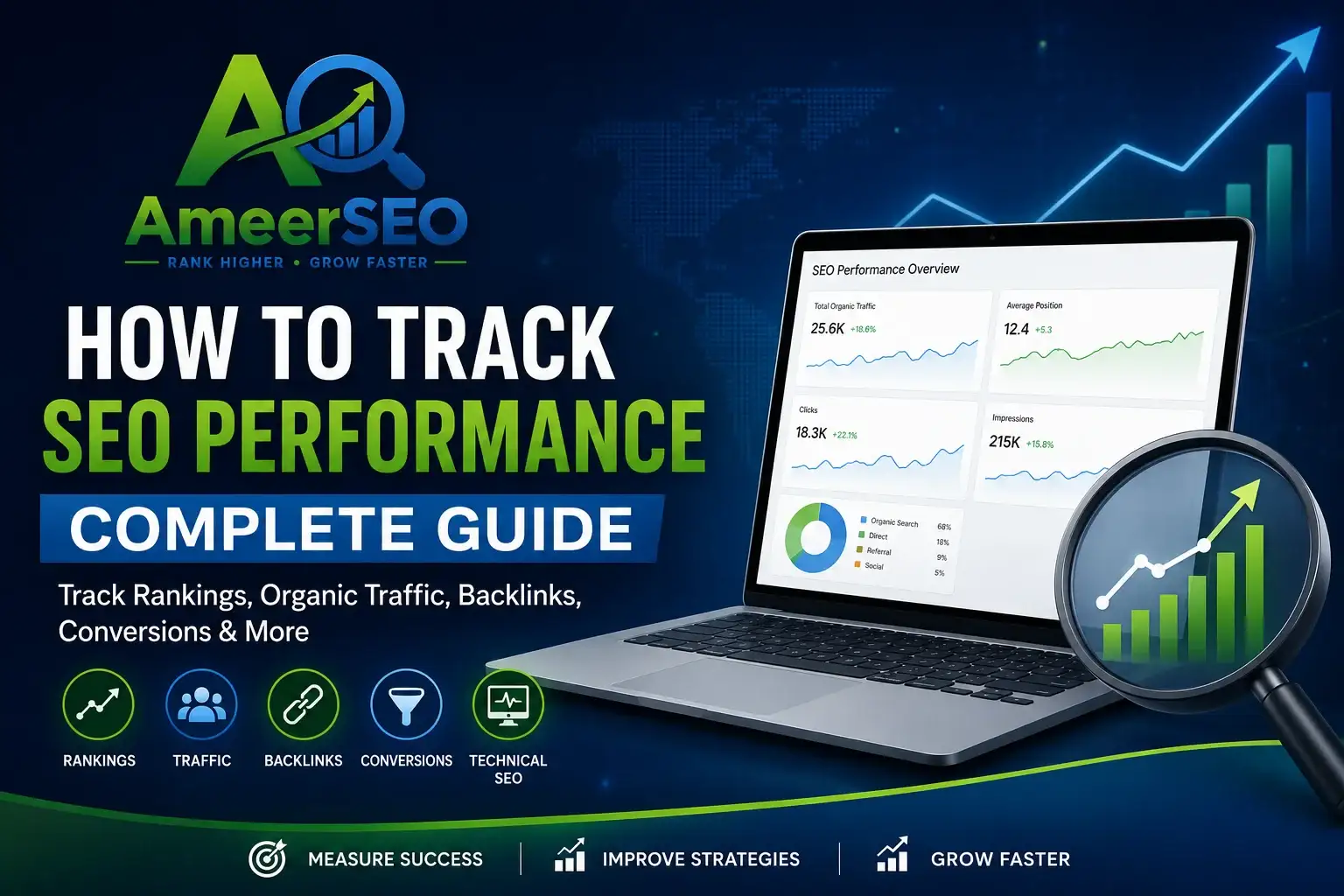
Search Engine Optimization is one of the most effective ways to grow a website, increase online visibility, and attract targeted visitors from search engines. However, simply optimizing pages and publishing content is not enough. Businesses and website owners must understand how to track SEO performance to measure progress, identify problems, and improve results over time.
Tracking SEO performance helps you understand whether your SEO strategies are bringing organic traffic, improving keyword rankings, increasing conversions, and boosting visibility in search engine results pages. Without proper SEO monitoring, it becomes difficult to know what is working and what needs improvement.
This complete guide explains how to track SEO performance, which SEO metrics matter most, and which tools can help you monitor search engine rankings, organic traffic growth, and overall website SEO health.
Why SEO Performance Tracking Matters
SEO is a long-term process. Rankings change regularly, competitors update their strategies, and search engine algorithms continue evolving. Tracking SEO performance allows website owners to make informed decisions based on real data instead of assumptions.
When you monitor SEO metrics consistently, you can identify which pages generate the most traffic, which keywords bring visitors, and which optimization efforts improve search visibility. SEO tracking also helps businesses measure return on investment and understand how organic search contributes to revenue and conversions.
Businesses that ignore SEO analytics often struggle to maintain rankings because they cannot identify technical issues, declining traffic trends, or keyword losses quickly enough.
Understanding SEO Performance Metrics
SEO performance metrics are indicators that show how well your website performs in search engines. These metrics help you evaluate website SEO health and measure SEO success accurately.
Organic traffic is one of the most important SEO indicators. It represents visitors arriving from search engines without paid advertising. Increasing organic search traffic usually indicates that your optimization efforts are working effectively.
Keyword rankings are another critical metric. Monitoring keyword positions helps you understand whether your pages are improving or losing visibility in search engine results pages. Ranking improvements usually lead to increased impressions, clicks, and traffic.
Click-through rate measures how often users click your website after seeing it in search results. A low click-through rate may indicate weak title tags or meta descriptions.
Bounce rate and user engagement metrics also help evaluate SEO quality. If visitors leave your website quickly, search engines may interpret the page as less useful for users.
Conversions are equally important. SEO traffic should contribute to leads, sales, or other business goals. Tracking conversions ensures your SEO campaign delivers actual business value rather than only traffic numbers.
Best Tools to Track SEO Performance
Several SEO reporting tools can help monitor website rankings, technical SEO health, and search visibility.
Google Analytics
Google Analytics is essential for tracking organic traffic analysis and user behavior. It helps website owners understand how visitors interact with pages, where traffic comes from, and which content generates conversions.
Through Google Analytics, you can track session duration, bounce rates, conversion rates, and traffic growth monitoring. These insights help businesses optimize pages for better engagement and performance.
Google Search Console
Google Search Console provides direct search engine data from Google. It helps monitor indexed pages, crawl errors, impressions, clicks, and keyword rankings.
Website owners can identify technical SEO issues, page indexing problems, and ranking fluctuations using this free SEO analytics dashboard. Google Search Console is also useful for monitoring mobile SEO performance and Core Web Vitals.
SEMrush
SEMrush is one of the most popular SEO tracking tools for keyword ranking monitoring and competitor analysis. It helps businesses analyze organic search traffic, backlinks, and domain authority.
The platform provides SEO benchmarking strategies and allows users to track keyword performance across multiple locations and devices.
Ahrefs
Ahrefs is widely used for backlink performance tracking and search visibility analysis. It helps identify high-quality backlinks, broken links, and competitor SEO strategies.
The tool also offers detailed keyword ranking data and content performance analysis for improving website authority and search rankings.
Screaming Frog
Screaming Frog is useful for technical SEO monitoring. It scans websites to detect crawl issues, duplicate content, broken links, and indexing problems.
Technical SEO health directly impacts rankings, making regular website audits necessary for long-term SEO success.
How to Track Organic Search Traffic
Organic traffic analysis is one of the easiest ways to measure SEO performance. If your optimization efforts are effective, search engine traffic should increase over time.
Google Analytics allows users to monitor traffic growth by navigating to acquisition reports. Website owners can compare monthly traffic trends and identify which pages attract the most visitors.
Tracking organic traffic also helps businesses understand seasonal changes and identify sudden ranking drops caused by algorithm updates or technical issues.
Traffic quality matters as much as traffic quantity. High traffic with low engagement or no conversions may indicate poor keyword targeting or irrelevant content.
Monitoring Keyword Rankings
Keyword ranking tracking is essential for understanding search engine visibility. Rankings determine whether users can find your website in search results.
SEO professionals often track primary keywords, secondary keywords, and long-tail variations to measure performance accurately. Monitoring rankings helps identify which pages require optimization and which keywords are driving traffic.
Ranking fluctuations are common due to algorithm changes and competitor activity. Consistent monitoring allows businesses to respond quickly to sudden drops in search visibility.
Local businesses should also track local SEO rankings because search results often vary by location. Mobile SEO rankings should be monitored separately since mobile-first indexing affects search performance significantly.
Measuring Click-Through Rate
Click-through rate is a key SEO metric that measures how often users click your website after seeing it in search results.
A high ranking alone does not guarantee traffic. If your titles and descriptions are not attractive, users may ignore your page even when it appears at the top of search results.
Improving title tags, meta descriptions, and structured data can increase click-through rates significantly. Search Console provides detailed CTR reports for analyzing page performance.
Pages with high impressions but low clicks usually need improved metadata or better keyword targeting.
Tracking Backlink Performance
Backlinks remain one of the strongest ranking factors in SEO. Monitoring backlink quality helps businesses understand how external websites influence domain authority and search visibility.
SEO tools like Ahrefs and SEMrush help track new backlinks, lost backlinks, and referring domains. High-quality backlinks from authoritative websites improve credibility and rankings.
Spammy or low-quality backlinks can harm SEO performance. Regular backlink analysis helps identify toxic links that may require removal or disavowal.
Link-building campaigns should focus on relevance, authority, and natural link acquisition instead of quantity alone.
Technical SEO Monitoring
Technical SEO monitoring ensures search engines can crawl, index, and understand your website properly.
Crawl error analysis is essential because broken pages, server errors, and redirect issues can negatively affect rankings. Google Search Console and Screaming Frog help identify these technical problems quickly.
Page speed and Core Web Vitals also play a major role in SEO performance. Slow-loading pages reduce user satisfaction and may decrease rankings.
Mobile SEO monitoring is equally important because Google primarily uses mobile-first indexing. Websites that perform poorly on mobile devices may lose visibility in search results.
Regular technical SEO audits help maintain website health and prevent ranking losses caused by hidden technical issues.
Tracking SEO Conversions
SEO success should not only be measured through traffic and rankings. Businesses must track conversions to understand the real impact of SEO campaigns.
Conversions may include contact form submissions, product purchases, phone calls, newsletter signups, or appointment bookings.
Google Analytics allows businesses to set conversion goals and monitor how organic search contributes to revenue generation.
Tracking SEO conversions helps identify high-performing landing pages and valuable keywords that attract customers instead of just visitors.
Comparing SEO Tracking Tools
| SEO Tool | Main Purpose | Best Feature | Suitable For |
|---|---|---|---|
| Google Analytics | Traffic analysis | User behavior insights | All websites |
| Google Search Console | Search performance monitoring | Keyword and indexing data | Website owners |
| SEMrush | SEO analytics and competitor research | Ranking tracking | SEO agencies |
| Ahrefs | Backlink analysis | Link monitoring | Advanced SEO users |
| Screaming Frog | Technical SEO audits | Crawl analysis | Technical SEO specialists |
Common SEO Tracking Mistakes
Many website owners focus only on rankings while ignoring conversions and user engagement. Rankings alone do not guarantee business success.
Another common mistake is tracking too many metrics without understanding which ones matter most. Businesses should prioritize organic traffic, keyword rankings, conversions, and technical SEO health.
Ignoring mobile SEO performance is another serious issue because mobile traffic dominates search activity worldwide.
Some businesses also fail to monitor competitor strategies, which makes it difficult to identify new opportunities and industry trends.
Regular SEO reporting and data analysis help avoid these mistakes and improve long-term performance.
How Often Should You Track SEO Performance?
SEO tracking frequency depends on your website size and competition level.
Keyword rankings and technical issues should be monitored weekly to identify sudden changes quickly. Organic traffic and conversion analysis can usually be reviewed monthly.
Comprehensive SEO audits should be performed every few months to evaluate website health and search visibility.
Consistent tracking helps businesses adapt to algorithm updates and changing search trends effectively.
Building an SEO Reporting Strategy
An effective SEO reporting strategy helps businesses measure progress clearly and communicate results effectively.
Reports should include traffic growth, keyword rankings, conversion performance, backlink data, and technical SEO insights.
Visual comparisons between previous and current performance periods make reports easier to understand.
Businesses should focus on actionable insights rather than overwhelming stakeholders with excessive data.
SEO reporting tools simplify data collection and help monitor long-term optimization progress efficiently.
Future of SEO Performance Tracking
SEO tracking continues evolving with artificial intelligence, automation, and advanced analytics.
Search engines increasingly prioritize user experience, page quality, and search intent. Future SEO monitoring will focus more on engagement metrics and behavioral analysis.
Voice search, AI-generated results, and personalized search experiences will also influence SEO measurement strategies.
Businesses that invest in modern SEO analytics tools and data-driven optimization strategies will maintain stronger search visibility in competitive markets.
Companies like Ameer SEO understand the importance of continuous SEO monitoring and strategic optimization for achieving sustainable online growth.
Conclusion
Learning how to track SEO performance is essential for improving search engine visibility, increasing organic traffic, and achieving long-term digital growth.
SEO performance tracking involves monitoring keyword rankings, organic traffic, backlinks, technical SEO health, and conversions. Using tools like Google Analytics, Google Search Console, SEMrush, Ahrefs, and Screaming Frog helps businesses collect valuable SEO insights and optimize their strategies effectively.
Successful SEO is not only about ranking higher in search results. It is about attracting targeted visitors, improving user experience, and converting traffic into measurable business results.
Consistent SEO monitoring allows website owners to identify opportunities, fix problems quickly, and maintain steady growth in an increasingly competitive digital environment.
FAQs
What is SEO performance tracking?
SEO performance tracking is the process of monitoring website rankings, organic traffic, backlinks, conversions, and technical SEO metrics to evaluate search engine optimization success.
Which tool is best for tracking SEO performance?
Google Analytics and Google Search Console are the best free tools for tracking SEO performance. Advanced users often use SEMrush and Ahrefs for competitor analysis and backlink monitoring.
How can I monitor keyword rankings?
You can monitor keyword rankings using tools like SEMrush, Ahrefs, Google Search Console, and dedicated rank-tracking software.
Why is organic traffic important in SEO?
Organic traffic indicates how many users visit your website through unpaid search engine results. It helps measure the effectiveness of SEO strategies.
How often should I check SEO rankings?
Keyword rankings should generally be checked weekly, while technical SEO audits and detailed performance reviews can be conducted monthly or quarterly.
What are the most important SEO metrics?
The most important SEO metrics include organic traffic, keyword rankings, click-through rate, conversions, bounce rate, backlinks, and search visibility.
How do backlinks affect SEO performance?
High-quality backlinks improve domain authority, credibility, and search engine rankings, while spammy backlinks can negatively impact SEO performance.
Can Google Search Console track SEO performance?
Yes, Google Search Console provides valuable data about impressions, clicks, indexing status, keyword rankings, and technical SEO issues.
What is SEO ROI?
SEO ROI measures the return on investment generated from SEO activities by comparing traffic, leads, sales, and revenue against optimization costs.
Why do SEO rankings fluctuate?
SEO rankings fluctuate because of algorithm updates, competitor changes, search intent shifts, technical issues, and content updates.