
Ameer SEO understands that one of the first questions healthcare providers ask before investing in search engine optimization is, “How long does it take for medical SEO to work?” The answer depends on several factors, including your website’s current condition, competition, content quality, and overall SEO strategy. While some improvements may appear within a few weeks, meaningful and sustainable results usually require several months of consistent effort.
Medical SEO is a long-term investment designed to improve healthcare website optimization, increase patient acquisition through SEO, and strengthen your medical practice’s online presence. Unlike paid advertising, SEO continues delivering value long after the initial optimization is completed.
What Is Medical SEO?
Medical SEO is the process of optimizing healthcare websites so they appear higher in Google search results when potential patients search for doctors, clinics, hospitals, or healthcare services. It combines technical optimization, content creation, local SEO, and authority building to improve search rankings.
Because healthcare belongs to Google’s Your Money or Your Life (YMYL) category, search engines expect medical websites to demonstrate expertise, experience, authority, and trustworthiness. This makes healthcare SEO more demanding than SEO in many other industries.
How Long Does Medical SEO Take?
Most healthcare websites begin seeing early improvements within 3 to 4 months. Significant increases in rankings, organic traffic, and patient inquiries generally occur between 6 and 12 months.
The exact medical SEO timeline depends on your website’s age, competition, technical health, content quality, and backlink profile. Clinics in highly competitive cities often require additional time compared to practices in smaller markets.
Medical SEO Timeline Explained
| Time Period | Expected SEO Progress | Typical Results |
|---|---|---|
| Month 1 | SEO audit, technical fixes, keyword research | Website improvements begin |
| Months 2-3 | Content optimization, local SEO improvements | Some keyword movement and indexing |
| Months 3-4 | Google starts recognizing improvements | Moderate ranking improvements |
| Months 4-6 | Increased authority and stronger optimization | Higher organic traffic and more patient inquiries |
| Months 6-9 | Consistent content and backlink growth | Better search rankings and lead generation |
| Months 9-12+ | Mature SEO strategy | Sustainable traffic, appointments, and long-term growth |
Why Medical SEO Takes Time
SEO involves earning Google’s trust rather than purchasing visibility. Search engines continuously evaluate websites based on hundreds of ranking factors before deciding where they deserve to appear.
Healthcare websites must also compete with hospitals, national healthcare organizations, established medical practices, and government health resources. Building authority in such a competitive environment naturally requires patience.
Factors Affecting Medical SEO Results
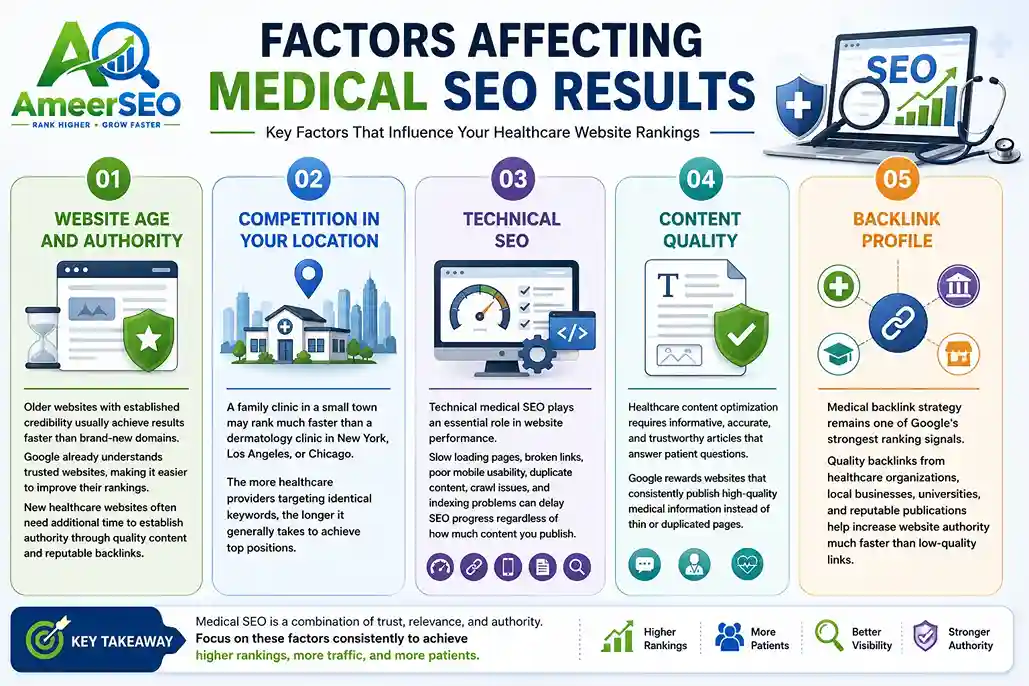
Website Age and Authority
Older websites with established credibility usually achieve results faster than brand-new domains. Google already understands trusted websites, making it easier to improve their rankings.
New healthcare websites often need additional time to establish authority through quality content and reputable backlinks.
Competition in Your Location
A family clinic in a small town may rank much faster than a dermatology clinic in New York, Los Angeles, or Chicago.
The more healthcare providers targeting identical keywords, the longer it generally takes to achieve top positions.
Technical SEO
Technical medical SEO plays an essential role in website performance.
Slow loading pages, broken links, poor mobile usability, duplicate content, crawl issues, and indexing problems can delay SEO progress regardless of how much content you publish.
Content Quality
Healthcare content optimization requires informative, accurate, and trustworthy articles that answer patient questions.
Google rewards websites that consistently publish high-quality medical information instead of thin or duplicated pages.
Backlink Profile
Medical backlink strategy remains one of Google’s strongest ranking signals.
Quality backlinks from healthcare organizations, local businesses, universities, and reputable publications help increase website authority much faster than low-quality links.
Local Medical SEO Works Faster for Many Clinics
Local medical SEO often delivers faster results than nationwide SEO because it targets patients within a specific geographic area.
Optimizing your Google Business Profile, earning patient reviews, maintaining accurate business information, and creating location-based content can significantly improve visibility in local searches.
Many clinics receive phone calls and appointment requests through Google Maps even before achieving top organic rankings.
How Google Ranks Medical Websites
Google evaluates medical websites using numerous quality signals before assigning rankings.
These include website speed, mobile responsiveness, secure HTTPS connections, relevant keywords, medical expertise, trustworthy author information, user engagement, structured data, backlinks, and overall website authority.
Healthcare websites demonstrating Experience, Expertise, Authoritativeness, and Trustworthiness (E-E-A-T) generally perform better over time.
Signs Your Medical SEO Is Working
SEO success is not measured only by reaching the first page of Google.
Positive indicators often appear much earlier. Increased keyword rankings, better indexing, higher organic traffic, longer visitor sessions, improved click-through rates, more phone calls, appointment requests, and additional patient inquiries all indicate steady progress.
These improvements usually build upon one another as Google gains greater confidence in your healthcare website.
Common Mistakes That Delay Medical SEO
Many healthcare providers expect immediate results after publishing a few pages.
SEO slows down when websites neglect technical optimization, publish low-quality medical content, ignore local SEO, purchase spammy backlinks, or frequently redesign pages without maintaining SEO best practices.
Consistency almost always outperforms shortcuts.
Can Medical SEO Produce Faster Results?
Certain improvements can accelerate progress, although no legitimate agency can guarantee instant rankings.
Some effective approaches include:
- Fix technical website issues immediately.
- Optimize every service page thoroughly.
- Publish helpful healthcare content regularly.
- Strengthen Google Business Profile optimization.
- Earn quality healthcare backlinks.
- Improve website speed and mobile experience.
- Collect genuine patient reviews consistently.
Even with these improvements, sustainable SEO growth remains gradual because search engines require time to evaluate changes.
Medical SEO vs Paid Advertising
| Feature | Medical SEO | Paid Advertising |
|---|---|---|
| Time to See Results | 3-12 months | Immediate |
| Long-Term Value | Excellent | Stops when ads stop |
| Cost Efficiency | High over time | Ongoing advertising costs |
| Trust Level | Higher organic credibility | Lower than organic listings |
| Traffic Growth | Sustainable | Temporary |
| ROI | Improves over time | Depends on ad budget |
Is Medical SEO Worth the Wait?
Absolutely.
While medical SEO requires patience, its long-term benefits often exceed those of paid advertising. A well-optimized healthcare website continues attracting qualified patients long after optimization work has been completed.
Practices that consistently invest in SEO typically experience stronger online visibility, increased patient acquisition, improved search rankings, and steady business growth.
Frequently Asked Questions
Most healthcare websites notice early improvements within 3 to 4 months, while stronger ranking improvements usually occur between 6 and 12 months.
Healthcare websites fall under Google's YMYL guidelines, requiring higher levels of trust, authority, accuracy, and expertise before achieving top rankings.
Yes, but new websites usually require additional time to build authority, earn backlinks, publish quality content, and establish credibility with search engines.
Yes. Local SEO often generates faster visibility through Google Business Profile optimization, local citations, patient reviews, and Google Maps rankings.
Website authority, content quality, technical optimization, competition, and high-quality backlinks collectively have the greatest influence on medical SEO performance.
Both strategies have advantages. Paid advertising delivers immediate visibility, while SEO builds long-term organic traffic, credibility, and sustainable patient acquisition.
Publishing high-quality healthcare content consistently, whether weekly or biweekly, helps improve search visibility, build authority, and answer patients' most common questions.
You can, but optimizing your Google Business Profile is highly recommended because it improves local search visibility, Google Maps rankings, and patient trust.
Conclusion
Medical SEO is not an overnight process, but it remains one of the most effective long-term marketing strategies for healthcare providers. Whether you operate a private clinic, dental practice, specialty center, or hospital, consistent optimization leads to stronger Google rankings, increased organic traffic, and more patient appointments over time.
By focusing on technical medical SEO, healthcare content optimization, local SEO, and authority building, your practice can achieve sustainable online growth and remain competitive in an increasingly digital healthcare landscape.