
Finding the right keywords is the foundation of every successful SEO strategy. At Ameer SEO, known as a reliable SEO Expert in Pakistan and offering an affordable SEO service in Multan, we understand that effective keyword research is what connects your website with the people searching for your products or services. This keyword research guide explains the complete keyword research process, helping beginners, marketers, bloggers, and businesses discover high-ranking SEO keywords that improve Google search rankings, increase organic traffic, and build long-term topical authority.
What Is Keyword Research?
Keyword research is the process of discovering the words and phrases people type into search engines. These search queries help businesses understand customer needs, search demand, and user behavior before creating content.
A strong SEO keyword research strategy ensures that every page targets relevant search engine optimization keywords instead of relying on guesswork. When you choose the right keywords, your content becomes more relevant to users, improving search engine rankings and attracting qualified visitors.
Keyword research is not simply about finding popular terms. It also involves understanding search intent, analyzing keyword difficulty, measuring search volume, and identifying keyword opportunities that competitors may have overlooked.

Why SEO Keyword Research Matters
Without proper keyword planning, even excellent content can remain invisible in Google Search. Search engines evaluate how well your page matches the user’s intent before deciding where it should rank.
Effective keyword targeting allows businesses to create content that answers real questions. This improves organic search visibility while increasing the chances of attracting visitors who are more likely to become customers.
Modern SEO depends on relevance rather than keyword stuffing. Search engines now evaluate context, semantic relationships, topical authority, and content quality to determine rankings.
Understanding Search Intent
Search intent analysis is one of the most important parts of keyword research.
Every search query has a purpose. Some users want information, while others are ready to purchase products or compare services. Understanding user search intent helps create content that satisfies both readers and search engines.
Generally, search intent falls into four categories.
Informational
Navigational
Commercial
Transactional
When your content matches user intent optimization, Google is more likely to rank your pages higher because they provide exactly what users expect.
Types of SEO Keywords
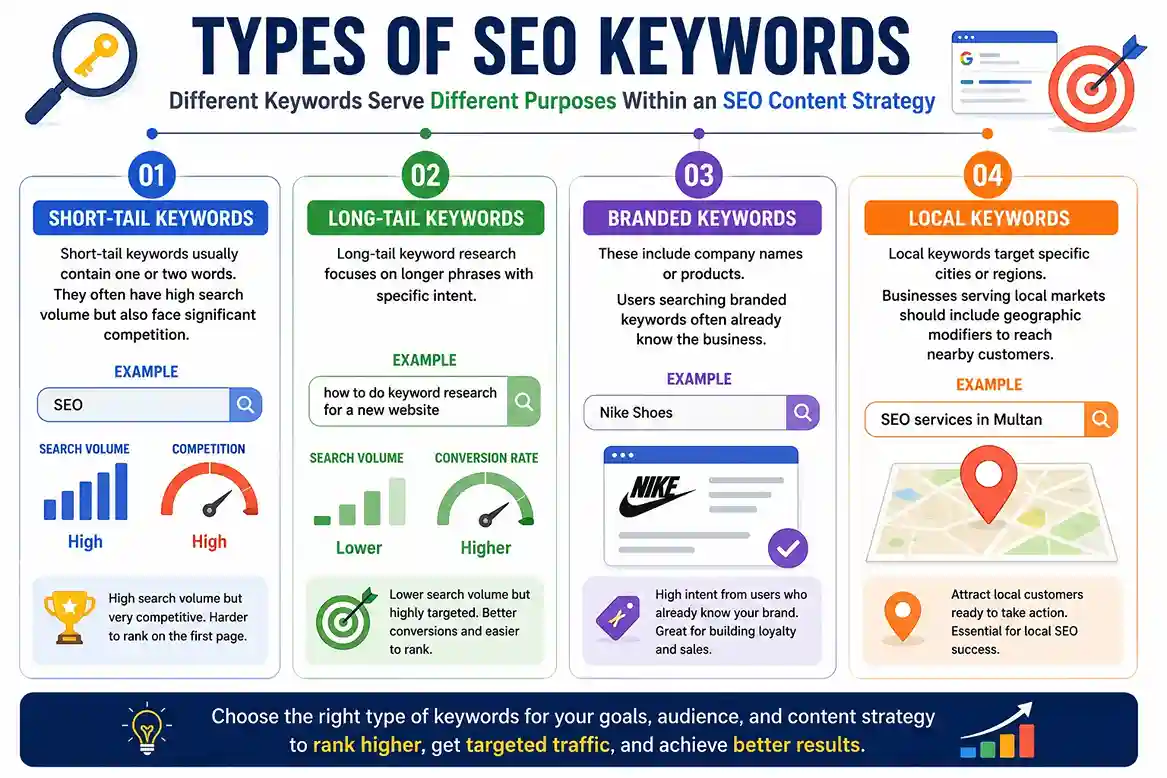
Different keywords serve different purposes within an SEO content strategy.
Short-Tail Keywords
Short-tail keywords usually contain one or two words. They often have high search volume but also face significant competition.
An example is “SEO.”
Long-Tail Keywords
Long-tail keyword research focuses on longer phrases with specific intent.
An example is “how to do keyword research for a new website.”
Although search volume may be lower, these keywords usually convert better because they match highly targeted searches.
Branded Keywords
These include company names or products.
Users searching branded keywords often already know the business.
Local Keywords
Local keywords target specific cities or regions.
Businesses serving local markets should include geographic modifiers to reach nearby customers.
How to Find SEO Keywords
Many beginners ask how to find SEO keywords effectively.
The first step is understanding your audience. Think about the problems they face and the solutions they seek.
Next, brainstorm broad topics related to your business. These become your seed keywords.
Expand those seed keywords using keyword research tools, Google autocomplete, related searches, and competitor research.
Finally, evaluate each keyword based on search volume analysis, keyword difficulty score, relevance, and business value before including it in your content optimization strategy.
Step-by-Step Keyword Research Process

Start With Seed Keywords
Seed keywords are broad topics that represent your products, services, or niche.
They provide the foundation for discovering hundreds of related keyword variations.
Analyze Search Volume
Search volume analysis estimates how often users search for a keyword.
High search volume may appear attractive, but competition should also be considered before selecting target keywords.
Evaluate Keyword Difficulty
Keyword difficulty measures how challenging it may be to rank on the first page.
New websites often benefit from targeting lower difficulty keywords while gradually building authority.
Study Competitor Keyword Research
Competitor keyword analysis reveals which search terms already drive traffic to competing websites.
Instead of copying competitors, identify keyword opportunities they have missed.
Perform SERP Analysis
SERP analysis helps understand what Google already ranks for your target keyword.
Study content length, search intent, headings, featured snippets, FAQs, images, and internal linking before creating your own page.
Build Keyword Clusters
Keyword clustering groups similar search terms together.
Instead of creating multiple thin pages, develop comprehensive content that covers an entire topic cluster.
This approach strengthens topical authority while improving content relevance.
Best Keyword Research Techniques
Successful keyword research combines multiple methods rather than relying on a single tool.
Use Google autocomplete to discover real search phrases.
Review Google’s “People Also Ask” section to understand common questions.
Analyze competitor pages that rank well.
Study industry forums where users discuss problems.
Monitor Google Trends to identify changing search demand.
Combine these techniques with professional keyword planning for better results.
Essential Keyword Research Tools
Several tools simplify Google keyword research and improve decision-making.
Google Keyword Planner provides keyword ideas and search volume estimates.
Google Search Console reveals keywords already generating impressions and clicks.
Google Trends identifies seasonal search patterns.
Ahrefs offers detailed competitor keyword research and backlink insights.
Semrush provides extensive keyword opportunities, keyword difficulty metrics, and SERP analysis.
Moz Keyword Explorer assists with keyword prioritization.
Ubersuggest helps beginners identify keyword variations.
AnswerThePublic uncovers questions users ask around specific topics.
KeywordTool.io expands keyword ideas from Google autocomplete.
Bing Webmaster Tools provides additional search performance data.
Using multiple tools creates a more accurate picture than relying on one platform alone.
Comparison Table of Popular Keyword Research Tools
| Tool | Best For | Strength | Ideal User |
|---|---|---|---|
| Google Keyword Planner | Google keyword research | Free keyword ideas | Beginners |
| Google Search Console | Existing rankings | Performance insights | Website owners |
| Google Trends | Search demand analysis | Trend monitoring | Content marketers |
| Ahrefs | Competitor keyword research | Comprehensive SEO data | Professionals |
| Semrush | SEO content planning | Keyword database | Agencies |
| Moz Keyword Explorer | Keyword prioritization | Easy interface | Small businesses |
| Ubersuggest | Beginner keyword research | Affordable features | Freelancers |
| AnswerThePublic | Search intent analysis | Question discovery | Bloggers |
| KeywordTool.io | Keyword expansion | Long-tail keywords | Content creators |
| Bing Webmaster Tools | Bing optimization | Additional search data | SEO specialists |
Keyword Mapping and Content Strategy
Keyword mapping assigns each primary keyword to a specific webpage.
This prevents pages from competing against one another while improving site structure.
Every page should focus on one primary keyword supported by semantic keywords, LSI keywords, keyword variations, and naturally related phrases.
A well-organized content keyword strategy also improves internal linking and topical relevance.
SEO Content Planning
SEO content planning begins after keyword research is complete.
Each article should answer user questions completely instead of repeating keywords unnaturally.
Include headings, relevant examples, supporting entities, and clear explanations.
Content optimization should focus on readability, user experience, and helpful information rather than simply increasing keyword frequency.
Common Keyword Research Mistakes
Many websites struggle because they target only high-volume keywords.
Ignoring search intent often results in low engagement.
Creating separate pages for nearly identical keywords causes keyword cannibalization.
Neglecting competitor analysis limits growth opportunities.
Publishing content without updating keyword research can make articles outdated over time.
Another common mistake is focusing solely on search volume while ignoring business relevance.
How Keyword Research Supports Organic Traffic Growth
Keyword research directly influences website traffic growth.
When content aligns with user needs, search engines reward it with better visibility.
Higher rankings increase impressions.
More impressions generate clicks.
More qualified clicks lead to better conversions.
Over time, this creates sustainable organic traffic without relying entirely on paid advertising.
Building Topical Authority Through Keyword Clustering
Topical authority develops when a website covers a subject comprehensively.
Instead of publishing isolated articles, create related content connected through internal links.
Topic clusters help search engines understand expertise while making navigation easier for users.
This strategy improves content relevance and strengthens search engine rankings.
Measuring Keyword Research Success
SEO is an ongoing process.
Track keyword rankings regularly.
Monitor click-through rate (CTR) using Google Search Console.
Measure organic search traffic in analytics.
Evaluate conversions alongside rankings because successful SEO should support business goals rather than vanity metrics.
Review keyword performance periodically and update content whenever search behavior changes.
Future of Keyword Research
Search engines continue evolving through artificial intelligence and natural language understanding.
Modern keyword research now emphasizes user intent, context, semantic relationships, and content quality.
Businesses that prioritize helpful content instead of keyword stuffing are more likely to achieve long-term success.
Future SEO will increasingly reward websites that demonstrate expertise, answer user questions thoroughly, and organize content into meaningful topic clusters.
Conclusion
Keyword research remains the cornerstone of every successful SEO campaign. From understanding search intent and evaluating keyword difficulty to performing competitor keyword research, SERP analysis, keyword mapping, and content optimization, every step contributes to better visibility in search engines.
By combining Google Keyword Planner, Google Search Console, Google Trends, Ahrefs, Semrush, Moz Keyword Explorer, Ubersuggest, AnswerThePublic, KeywordTool.io, and Bing Webmaster Tools, you can build a comprehensive keyword strategy that supports long-term growth. Focus on relevance, user intent, semantic SEO, and topical authority rather than simply chasing high search volume. Consistently updating your keyword research and content strategy will help your website earn stronger rankings, attract qualified visitors, and drive sustainable organic traffic.
Frequently Asked Questions
What is keyword research in SEO?
Keyword research is the process of finding the words and phrases people search for in search engines so you can create content that matches user intent and improves search rankings.
Which is the best free keyword research tool?
Google Keyword Planner, Google Search Console, and Google Trends are among the best free tools for discovering keyword ideas and analyzing search performance.
What is keyword difficulty?
Keyword difficulty estimates how challenging it is to rank for a particular keyword based on the strength of competing websites.
Why is search intent important?
Search intent helps you understand what users expect when searching. Matching that intent improves user satisfaction and increases ranking potential.
How often should keyword research be updated?
Review your keyword strategy every few months or whenever market trends, customer behavior, or search demand changes significantly.
What are long-tail keywords?
Long-tail keywords are longer, more specific search phrases that usually have lower competition and higher conversion potential.
What is keyword mapping?
Keyword mapping assigns specific keywords to individual pages, helping prevent keyword cannibalization while improving website organization.
Can I rank without keyword research?
It is possible, but unlikely to achieve consistent results. Proper keyword research improves content relevance, visibility, and long-term organic traffic growth.